

Modernize or fail: why investing in your IT infrastructure is critical to future-proof all enterprises
- Coevolve
Today, CIOs must act as architects of change, modernizing their enterprise’s underlying digital infrastructure or WAN technology stack. And while these IT considerations should be critical items on the boardroom agenda, they’re not. But if CIOs and IT leaders fail to modernize their core critical infrastructure, they won’t keep pace with the changing business landscape, nor be able to operate effectively. In a nutshell, an enterprise’s business strategy must align with its network and security strategy. They both must be in sync to achieve overall organizational success.
According to Ernst & Young, 85 percent of CEOs are prioritizing investments in emerging technologies, underscoring the prevalence of adopting digital-led innovation and why it’s so critical to ensure your business networking foundation is ready for this next wave of technology. The time to act is now to ensure enterprises are set up for success because only then can business continuity be achieved. The investments made in this critical area address specific business needs.
Successful CIOs are not risk-averse; they can’t be. They recognize the value in modernizing their infrastructure and WAN technology stack, viewing these areas as a vital business imperative for operational efficiency and competitiveness. Yet, in the modern landscape, we see that some CIOs continue to bet on the wrong innovations and do not address their underlying core infrastructure to ensure all current and future IT projects succeed. This path not only drives up costs but also increases the risk of project failure, a risk few enterprises can afford in today’s fast-moving, competitive landscape.
IT projects are failing at an alarming rate
According to International Data Corporation (IDC), most (83 percent) enterprises are rationalizing away all the significant flaws of their technology infrastructure instead of modernizing, despite only 35 percent saying rationalization has been effective. According to CIO magazine, a “tsunami of IT project disasters is on the horizon” due to these 4 elements:
- There are twice the number of big projects in flight scheduled to go live.
- Bias and a lack of reporting when projects fail.
- A lack of talent and collaboration between teams.
- Untested methods and lack of a use case.
According to a Melbourne Business School whitepaper, the failure rate of projects is around 80 percent, but this problem extends beyond analytics and AI projects, affecting many other critical areas. These project failures are underpinned by their often-outdated IT infrastructure and WAN technology stack, demonstrating that leaders can fail their businesses by not modernizing.
Below, we outline the key opportunities that enterprises can leverage to ensure not only ROI on future IT projects but also ensure business continuity during this unprecedented time of change.
Opportunity #1 – Business continuity assurance: supports ROI IT projects and reveals cost savings
To ensure business goals are met when modernizing IT infrastructure, an enterprise’s overarching business strategy and network strategy must be aligned. This alignment creates a resilient foundation that supports long-term growth and operational continuity. Strategic investment in core infrastructure not only safeguards day-to-day operations but also enables future scalability.
Regarding the ROI implications and other benefits enterprises will experience, our client was able to leverage our expertise to reduce network costs by 40%. While this alone was impressive, we also helped them to increase their bandwidth fivefold and boost their network visibility and
management. Now, the organization has the reliable, secure, and high-performance connectivity it needs, guaranteeing seamless access to critical resources across all locations and positioning them to remain agile and ready to adopt emerging technologies as business needs evolve.
Opportunity #2 – Drive innovation to become a top-performing enterprise
Innovation fuels business expansion, growth, and boosts productivity, but it can also cause disruption and wreak havoc if unprepared. By partnering with experts in network modernization, enterprises can confidently adopt emerging technologies while maintaining control and security. The beauty of modernizing IT infrastructures is that it gives IT leaders a comprehensive, real-time view of their entire digital ecosystem, enabling them to monitor performance, manage costs, assess risk, and scale with confidence. This visibility empowers faster, more informed decision-making and ensures the business remains agile and resilient in the face of constant change.
In practice, our client replaced their legacy Multi-Protocol Label Switching (MPLS) with a telco-independent SD-WAN, achieving not only increased network performance and enhanced network security but also enabling the enterprise to elevate its cloud security strategy to take a more granular mindset to cloud access, security brokering, and data loss prevention measures. Their new modernized networking capabilities empowered this client to experience greater global collaboration and innovation, embrace cloud-first strategies, and adapt seamlessly to the demands of a digital-first world.
Opportunity #3 – Robust connectivity, reinforced by strengthened cybersecurity
According to UN’s International Telecommunication Union, the importance of investing in digital infrastructure is “ultimately about unlocking human potential and economic growth.” While this statement broadly addresses the transformative power of connectivity for humanity, its essence equally applies to businesses. The benefits of an upgraded infrastructure are practically limitless, as they have so many positive effects on enterprises, but strengthening global connectivity to support business continuity is critical for any business, large or small. This newfound connectivity drives efficiency, innovation, and competitiveness in our hyperconnected world.
With the proper IT foundation, CIOs and all IT leaders can also ensure their organization has enhanced the cyber-secure posture it needs in this threat-heavy world. According to IDC, 41 percent of enterprises say that the objective of IT modernization is to improve cybersecurity, highlighting that this is a key reason to update their infrastructure. Whereas legacy IT infrastructure is a massive risk, often leaving businesses vulnerable to cyber threats just by existing, requiring patching and costly updates.
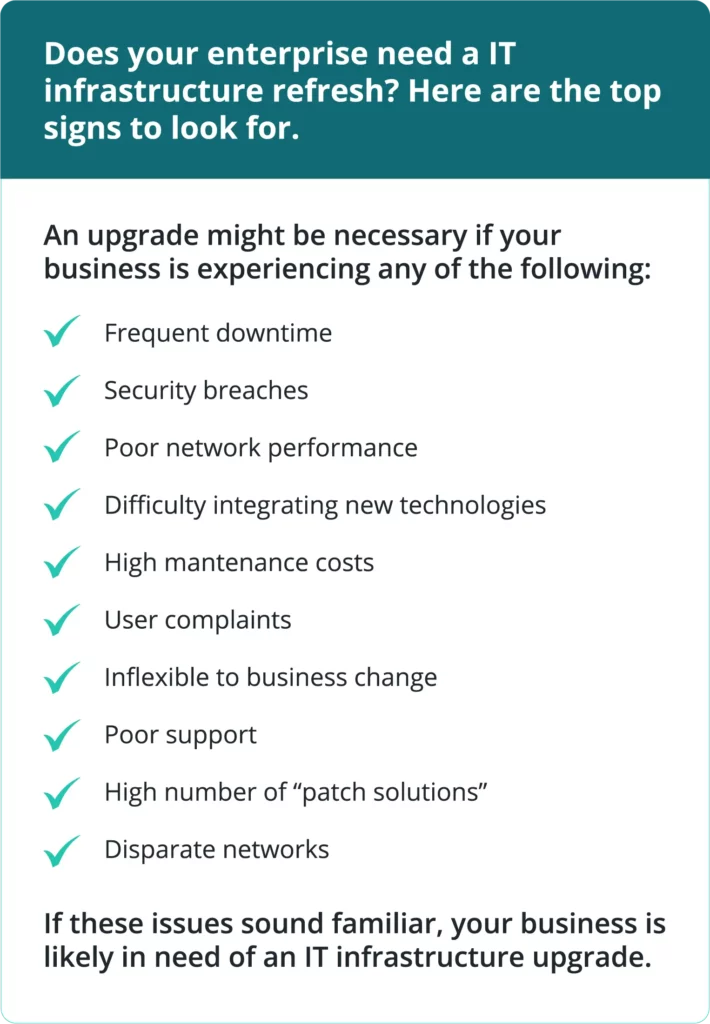
The benefits of unlocking these key opportunities
In today’s competitive business landscape, unlocking advanced connectivity and modern IT infrastructure is key to staying agile, secure, and ready for innovation. These investments not only drive stronger ROI from technology adoption but also lay the groundwork for long-term business continuity. We’ve seen that enterprises that modernize their WAN architecture and align network strategy with broader business objectives are better equipped to adapt, scale, and thrive—no matter what the future brings.
According to our client, connectivity is the backbone of their operations, ensuring that their team, no matter where they are located, can collaborate seamlessly and access the resources they need. Through our partnership, they unlocked significant value through experiencing secure, and high-performance connectivity that supports their business objectives and mission. To learn how to replicate their success, read our eGuide or contact us today.