

Bridging the AI readiness gap: Rewriting the AI narrative for manufacturers
- Coevolve
The current narrative for AI
Industry 4.0 has created both new opportunities and additional pressures for manufacturers around the world, particularly with the rise of AI. Driven by competition, ambition, and necessity, manufacturing leaders are increasingly investing in and implementing AI-driven systems to enhance productivity and efficiency gains, but in the same breath, they tread with caution.
The manufacturing edition of our Global Business Connectivity Outlook Report 2025–2026 reinforces this dichotomy. In the next 12 months, 40 percent of leaders will implement new systems and solutions in their organizations, while a further 20 percent are upgrading existing systems to upscale.
However, our findings also show clear signs of hesitation surrounding AI adoption, with 60 percent of leaders improving or adding to their existing infrastructure in the next 12 months. A further 40 percent are merely considering audits and systems reviews. This suggests manufacturing leaders don’t feel ready to fully commit to smart transformation.
What’s holding manufacturers back?
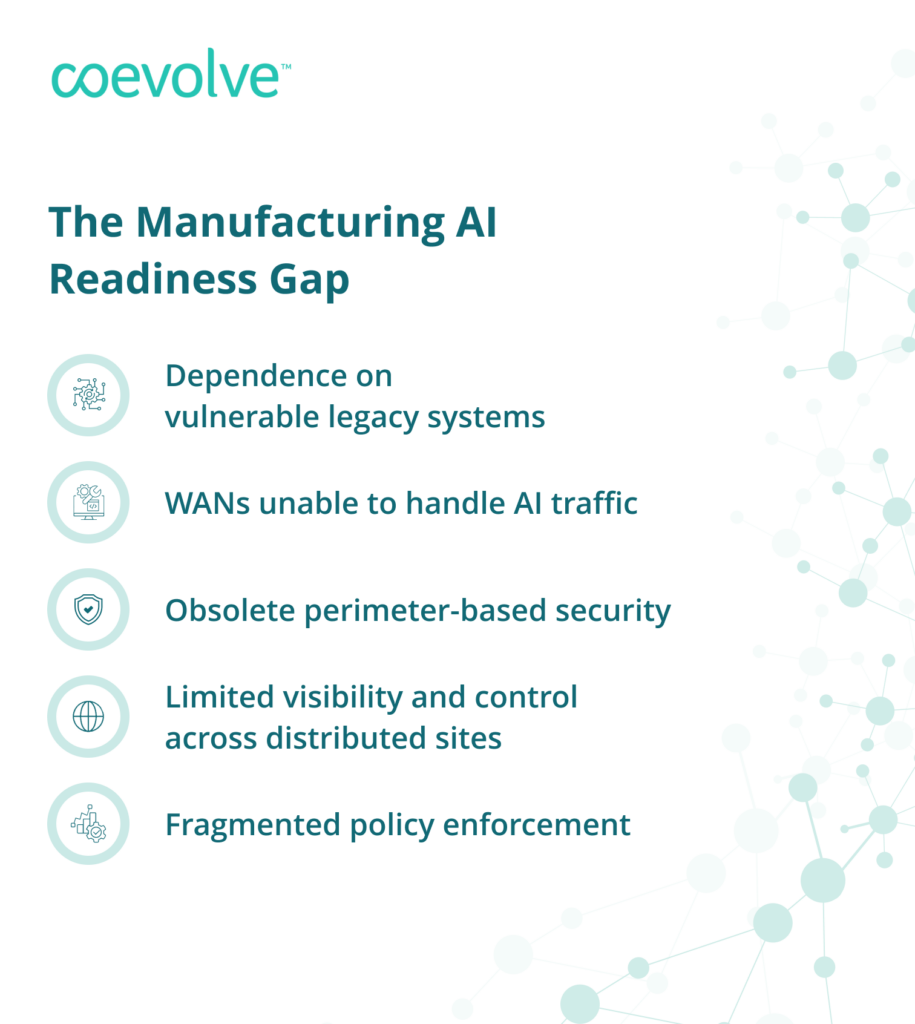
The current hesitation among manufacturing leaders is primarily due to concern over existing systems. Such systems typically can’t support or empower fast AI innovation because of inadequate capability or security, resulting in a reluctance to take risks with new innovations.
AI and other Industry 4.0 initiatives are often introduced into company Wide-Area Networks (WANs) and IT environments not designed or equipped for always-on and interconnected operations. Coupled with manufacturers’ dependence on legacy solutions, this leaves leaders nervous about the potential operational disruption and loss that can result from malfunctions, poor implementation, or failed legacy-system integration attempts.
In 2025, Tennant, an industrial cleaning equipment manufacturer, rolled out a new Enterprise Resource Planning (ERP) software platform intended to scale its digital transformation. The aim was to scale by standardizing global operations and improving operational visibility. However, faulty implementation and integration instead disrupted Q4 manufacturing operations across America, leading to approximately US$30 million in lost sales, at least US$20 million in ongoing remediation, and a share price drop of 23 percent in a single day.
As evidenced in this example, manufacturing systems and networks are often still protected by traditional, perimeter-based security that provides inadequate visibility and access control for AI operations. That is further complicated by the fragmented, multi-site nature of manufacturing today, which presents an ever-expanding, gap-filled attack surface leaders can’t afford amid a hostile threat landscape.
Recent research shows that cyber-attacks are increasing, and manufacturing is one of the most highly targeted sectors in the world. IBM found that the average cost of a breach for manufacturers in 2025 was US$5 million per breach, ranking only behind healthcare and financial industry breaches.
For manufacturers today, rushing ahead with AI and other emerging technologies and innovations looks like a risky recipe for financial and reputational loss. That’s why manufacturing leaders must be strategic and visionary in their approach to AI readiness and adoption.
Holding back can cost more in the end
To be slow in adopting Industry 4.0 also imposes its own opportunity costs. KPMG recently reported that nearly two-thirds of surveyed companies globally found meaningful business value from their AI investments in 2025-2026, while a similar proportion told McKinsey that AI was enabling innovation for them.
At the same time, Deloitte reported that manufacturers using smart manufacturing in 2025 saw 20 percent higher production output and employee productivity, and a 15 percent increase in production capacity. Clearly, missing out on these key opportunities for improvement creates a competitive gap that will only grow as businesses struggle to adapt.
Those businesses that can confidently adopt AI compound their advantage over AI laggards. So, seemingly caught between a rock and a hard place, how can businesses embrace innovation without opening the door to unmanageable security risk?
The new AI narrative: security is the enabler, not a barrier
The first step is for manufacturers to recognize that having to choose between security and AI innovation is a false dichotomy. The current AI narrative arose from the perception of security as a cost center and barrier to fast technological innovation. Yet, overlooking security is exactly why manufacturers lack the confidence to innovate and get ahead.
Having robust security across the network is not an inconvenience. Rather, it’s the foundation that enables safe and successful deployment of all technologies, beyond AI. More than purely protecting operational integrity, robust security also builds crucial customer and employee trust, and safeguards confidence in future innovation.
Modern manufacturers therefore need to rewrite today’s AI narrative and reframe security as a competitive advantage. That way, leaders can bridge their AI readiness gaps with confidence and optimism.
A good AI is a secure, reliable AI
For today’s manufacturers, the first step to AI integration is to recognize that using AI to drive competitive advantage doesn’t come from deploying it faster. It stems from the enterprise’s ability to reliably run AI across every production site and environment; a reliability made possible by strong security and connectivity positioned as a prerequisite for transformation and baked into the network.
When done right, AI underpinned by robust security has the potential to help manufacturers scale while ensuring that every site, sensor, device, and platform can function effectively. Highly secure AI solutions feed trustworthy, accurate data into existing models without opening the organization up to external attack, disruption, or data corruption. In this way, a good AI approach offers new opportunities to expand and grow.
Bridging the AI readiness gap with network security
To achieve AI readiness with network security at the helm, manufacturers must move away from perimeter-based security. The days of “if a breach happens” are long gone; “when a breach happens” is now the norm. AI’s increasing prevalence and autonomous access also make old perimeter-based security obsolete. There is now no single network chokepoint or defined “perimeter” that can be defended monolithically. A holistic network-level defense is needed to get ahead.
Today’s manufacturing IT leaders must help their enterprises pivot from conventional static, on-site security architecture to a data-centric, Zero Trust architecture that achieves the following:
- Assumes a breach
- Prevents lateral movement through network segmentation
- Ensures constant visibility and control over traffic even within trusted network spaces, through continuous authentication
- Continuously monitors threats and responds in real-time through automated threat detection
As AI operations become more distributed and pervasive in manufacturing operations, the Zero Trust approach can extend across all the distributed manufacturing touchpoints that AI encounters. This ensures rigorous protection in a multi-layered traffic and access environment.
The convergence is where enterprise network and security architecture must be the control plane for AI governance. The WAN is now the only universal enforcement point where all AI usage becomes visible, classifiable, and governable, regardless of tool, user, or endpoint, meaning it must be a key focus for leaders.
Incorporating network security into a single unified Secure Access Service Edge (SASE) framework gives manufacturers the centralized visibility and enterprise-wide Zero Trust enforcement to truly unlock the benefits of AI. This approach will help leaders to effectively govern AI usage and access uniformly and at scale, across all distributed environments.
A more confident AI future with network security
Robust network security is no longer an afterthought or a good-to-have. Leaders must build the right network security infrastructure to support the demands of AI readiness in manufacturing and lay the foundations for a more resilient, consistent, and governable manufacturing environment. To elevate Industry 4.0 ambitions for today’s manufacturing leaders, the time is right to embrace AI with solid and highly secure foundations.
Table of contents




FAQs
What kind of WAN should manufacturers invest in to get ahead in Industry 4.0?
Manufacturers should invest in a software-defined network and security architecture that can securely connect sites, users, applications, cloud platforms, and operational technology environments. The goal is to gain greater visibility, automation, and control while supporting the growing demands of IoT, AI, and cloud-based workloads.
A co-managed operating model is often the best fit, combining internal ownership with specialist expertise to improve resilience, accelerate innovation, and maintain strong security across increasingly complex environments.
What are the respective advantages of a co-managed SD-WAN, an DIY SD-WAN, and a fully managed SDWAN for manufacturers?
A DIY SD-WAN is one that the manufacturer fully designs, deploys, and manages themselves with no external managing partner to support them. Conversely, a fully managed SD-WAN is one that a manufacturer has outsourced completely to a network partner. A co-managed SD-WAN sits between them, with the manufacturer and their partner collaborating and sharing responsibility over the network lifecycle.
Each ownership option offers different advantages and tradeoffs in terms of flexibility, control, and resourcing, as shown in the table below. In most cases, choosing a co-managed SD-WAN solution is a best-of-both-worlds approach for manufacturers. However, the most suitable choice of SD-WAN model for any given manufacturer should ultimately be decided based on their specific context, capabilities, and priorities.
| DIY | Co-managed | Fully managed |
Maintain control of strategy and governance | ✓ | ✓ | Partial |
Access specialist network & security expertise | ✗ | ✓ | ✓ |
24/7 monitoring and support | ✗ | ✓ | ✓ |
Reduced burden on internal teams | ✗ | ✓ | ✓ |
Flexibility to adapt as business needs change | ✓ | ✓ | Partial |
Addresses network and security skills shortages | ✗ | ✓ | ✓ |