
The operational reality of AI: How enterprise network teams survive the AI boom
- Coevolve
For network teams, reality is split into two periods: Before AI and After AI.
Enterprise traffic used to adhere to a human-centric, north-south baseline. Requests were predominantly unicast, sent from end-user devices to central hubs—data centers, cloud hosts, or SaaS applications—and traffic flows were generally small, asynchronous, and short-lived. Smaller packet sizes meant relatively high tolerance for latency and jitter, and standard hashing algorithms were sufficient to route and distribute traffic evenly across available links. As a result, network architectures engineered around these predictable, human-driven patterns were more than enough to handle enterprise workloads.
Modern AI workflows, however, have overturned the apple cart. Autonomous AI agents, real-time Retrieval-Augmented Generation (RAG) pipelines, and GenAI models have resulted in high-velocity, east-west complexity that traditional enterprise networks were never engineered to handle. Most, if not all, of AI traffic is multi-cast and synchronous, meaning several one-to-all, all-to-one, or all-to-all requests could be hitting the network at the same time from multiple senders. These massive “elephant flows” have become long-lived, continuous, and high-volume—and these entirely new traffic behaviors are causing traditional network management strategies to break down.
What makes this challenge more complex is that much of this traffic is being generated by AI usage that organisations are still learning to govern. AI copilots, embedded SaaS capabilities, autonomous agents and third-party AI services are increasingly becoming part of day-to-day operations, often creating new traffic patterns, data flows and dependencies that are difficult to identify using traditional monitoring approaches.
To up the stakes, AI-driven workflows are also extremely sensitive to latency and jitter. A single microsecond tail-latency spike or dropped frame could force an entire job stall or execution failure. Therein lies the bottleneck: even the most well-designed AI applications will fail to deliver if the underlying digital foundation cannot support it.
Then there is the security challenge. Where perimeter firewalls and IP boundaries used to suffice Before AI, enterprise networks After AI require more dynamic strategies, such as Zero Trust Network Access (ZTNA) with micro-segmented, inline-level payload security and unified observability.
For many IT leaders, the challenge isn't simply deploying AI. It's understanding how rapidly growing AI usage is changing operational risk, governance requirements, and infrastructure demands across the enterprise. As employees adopt AI tools and vendors embed AI capabilities into everyday applications, many organisations are finding their networks are being asked to support workloads they were never designed to handle
The tactical chaos of managing a network in the AI era
It is clear that AI is fundamentally changing the enterprise WAN. Yet, network teams are under immense pressure to deliver lossless performance—while being strapped to infrastructural frameworks that were never designed nor built for machine-speed computational demands in the first place.
Of the key operational issues IT leaders are actively trying to solve, three stand out:
Telemetry overload and skill mutation
We’ve reached the inflection point in enterprise network operations (NetOps) where the sheer volume of monitoring data being generated has outpaced human triage capacity. Enter modern AIOps, which promises to usher enterprises out of the dark ages of manual triage and into the new world of self-healing, automated, and proactive network management.
But as AI analytics and machine learning routines get integrated into network monitoring tools, the operational burden for teams has transitioned from finding network problems to governing the automated tools that claim to have found them. Network engineers are frequently finding themselves having to validate conflicting diagnoses and AI-driven recommendations generated by isolated monitoring stacks—often resulting in alert fatigue, decision paralysis, and the ability to act on actual insights.
Because of this, engineering skill profiles are undergoing a forced “skill mutation”. Traditional domain expertise is no longer sufficient on its own. Modern network engineers must acquire capabilities in prompt and context governance, algorithmic verification, and model security analysis. Only then can engineering teams establish structured verification frameworks to validate, audit, and detect anomalies in AI-generated recommendations.
GenAI workloads are breaking the network
Network teams are being blamed for slow application response times, but they lack the specific observability layers required to monitor AI traffic as it crosses the WAN. GenAI traffic doesn’t originate in the data center; it originates at the branch or the home office, and it leaves the enterprise edge headed for model providers and AI-enabled SaaS. Payload-aware, session-level observability metrics are required to isolate where an AI transaction actually slowed down: the branch underlay, the SD-WAN overlay, the internet path, or the provider itself. Legacy network visibility tools, built to report on link utilization and device health, cannot make that distinction.
At a physical level, the branch edge is where this breaks first. GenAI has inverted the traffic profile at every site: where a branch once carried predictable, low-volume sessions to a handful of internal applications, it now carries sustained, high-volume flows to external model endpoints, and it carries far more of them at once. A single employee running an agentic workflow no longer generates one request; the agent decomposes the task and fires dozens of concurrent calls to retrieval services, model APIs and downstream tools, each holding an open session and streaming responses back. Multiply that across a site and a branch WAN sized for email, voice and a few SaaS applications is saturated by a handful of users, with congestion and buffer exhaustion appearing at the edge long before anyone in the data center notices anything.
WAN path selection compounds the problem. Standard hashing algorithms distribute sessions across available links using packet header fields, but GenAI traffic from a branch converges on a small set of provider endpoints over long-lived, encrypted sessions, so those flows hash identically and pin to the same uplink, saturating one circuit while a parallel broadband or 5G path sits idle. Because the flows are persistent rather than short-lived, conventional per-flow load balancing never gets the opportunity to rebalance them. The result is localized oversubscription at individual sites: one branch degrades while the aggregate WAN looks healthy on the dashboard, and backhauling that traffic to a central breakout only moves the congestion point rather than removing it.
The automation fear
Advanced security and network tools such as AIOps platforms aggressively market “autonomous remediation”. Their AI agents offer continuous monitoring, rapid threat identification, and automated remediation without requiring human intervention. They are capable of instantly patching firewalls, revoking identity permissions, automatically isolating hosts, and switching configurations in real time.
But no rational IT director will actually turn this on. No leader will fully enable unconstrained, autonomous remediation across production networks—because the blast radius of an erroneous action is simply too high an operational risk to bear. One wrong action from an agent within a live production environment can cause severe, cascading infrastructure outages.
The managed response is to adopt a Human-in-the-Loop (HITL) governance framework that sets operational boundaries for what AI agents can and cannot execute autonomously. Events are tiered by risk level, with strict escalation thresholds. Low-risk, diagnostic assembly actions such as log gathering, topology mapping, and ticket drafting can be fully automated. Medium-risk, reversible actions such as dynamic bandwidth throttling can be policy-dated. High-impact, critical-level actions such as node isolation require explicit, authenticated human approval.
Using your network as the governance plane for AI
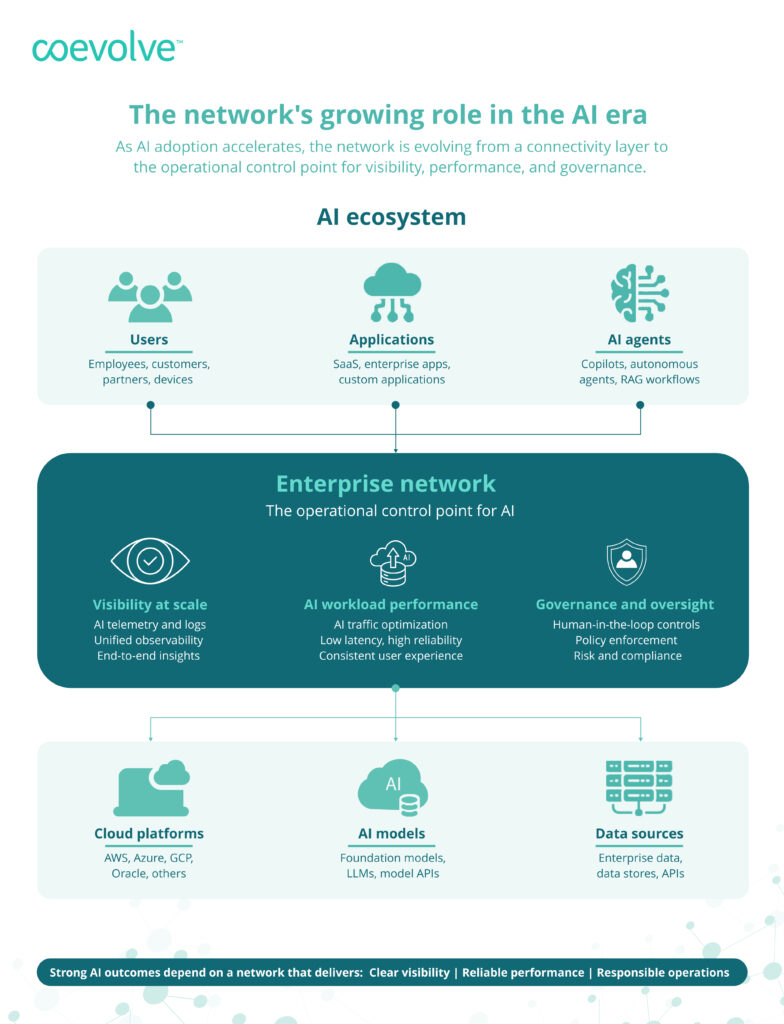
Deploying AI introduces new questions around visibility, governance, and control. Many organizations are discovering that their biggest challenge is understanding how AI is being used across the business. AI copilots embedded in SaaS platforms, external AI services, automated workflows and emerging AI agents are creating new traffic patterns and data flows that sit outside traditional governance processes.
Network and security teams historically focused on where traffic was going and whether it should be allowed. AI changes that equation. A connection to a model provider or API may look legitimate, yet reveal little about what data is being exchanged, what action is being requested, or what business process is being influenced. As AI adoption accelerates, organizations are discovering that they need more than just visibility into network – they also need visibility into intent, understanding not just where AI interactions are happening, but what they are doing and the risk they may introduce.
The network is central in the AI era. Regardless of whether an interaction originates from a user, application, API, or autonomous agent, it generates network traffic, making the network one of the few places where AI activity can be consistently observed and governed across the enterprise.
The network therefore evolves from a transport layer into an operational control plane for AI, providing a consistent point to enforce access controls, protect sensitive data, monitor AI activity, and apply human oversight to high-impact automated actions, regardless of the model or platform being used.
To understand where your network environment stands today, take our AI Security Score Assessment. It provides a practical benchmark of your organisation’s readiness to support AI securely, responsibly and at scale.
Table of contents

FAQs
How is generative AI changing enterprise network requirements?
Traditional enterprise networks were engineered based on predictable, north-south traffic patterns and high tolerance for latency. Generative AI changes the game by generating dynamic, high-velocity, east-west “elephant flows” and synchronous requests that are acutely sensitive to latency. Furthermore, generative AI traffic originates at the branch edge, where dozens of concurrent sessions can overwhelm local buffers and cause localized WAN congestion. Because microsecond tail-latency spikes can cause entire AI jobs to fail, network requirements must shift from static perimeter bandwidth to dynamic SD-WAN path steering, expanded edge buffer capacity, and session-level observability to maintain performance across distributed environments.
How can enterprise networks help govern AI use?
Because every interaction from a user, SaaS copilot, API, or autonomous agent generates network traffic, the network itself can serve as an operational control plane to govern AI activity. Through ZTNA with micro-segmentation, Secure Access Service Edge (SASE) architecture, and inline payload inspection, network teams can enforce access policies, protect sensitive data from leaking into model training pipelines, and oversee shadow AI usage.
Should enterprises allow AI to automatically remediate network issues?
Unconstrained autonomous remediation carries extremely high operation risk; a single erroneous action by an agent can trigger cascading failures and production outages. Organizations should instead adopt a Human-in-the-Loop governance framework with operational boundaries tiered by risk. Low- and medium-risk actions can be executed autonomously or gated by policy, but high-risk actions should always require authenticated human approval before execution.
How can IT teams monitor and manage AI traffic across enterprise networks?
Payload-aware, session-level observability across the WAN enables IT teams to identify whether latency occurs in the branch underlay, the SD-WAN overlay, the internet path, or the external model provider itself. Additionally, NetOps teams must acquire structured training to address “skill mutation”. Modern IT teams need to be trained in prompt governance and algorithmic verification to audit AIOps recommendations, manage telemetry overload, and resolve alert fatigue.