

Predictive NetOps: Turning network data into operational intelligence
- Coevolve
Network failures are an enterprise risk management challenge. For every minute your network goes down, you lose $15,000. According to Oxford Economics, that is the average cost per minute of unplanned service disruptions – a compounding mix of immediate transactional losses, plummeting stock prices, regulatory fines, and service-level agreement (SLA) penalties.
And here is the paradox: data from Uptime Institute reveals that, while investments in physical and digital redundancies may have successfully reduced the number of outages, any incidents that do occur are far more complex and catastrophic than before. 57 percent of major outages now cost over $100,000 per incident, with one in five costing over $1 million.
Despite these staggering statistics, a disconnect remains in enterprise boardrooms. According to our Global Business Connectivity Outlook Report, only 55 percent of leaders view high-performance connectivity as fundamentally critical, even though it forms the very backbone of business continuity and operational efficiency.
Executive leaders routinely demand flawless, “always-on” connectivity to safeguard revenue and customer trust – yet continue to treat global network operations (NetOps) as a commoditized, back-office support function rather than a core strategic priority. As AI adoption accelerates, that mindset is becoming increasingly risky. Secure connectivity is no longer just an operational requirement. It is the foundation for innovation, resilience, and growth.
Why traditional network operations are reaching their limits
The challenge facing enterprise IT leaders today is no longer simply preventing outages. It is managing the growing complexity behind them.
Modern enterprise networks bear little resemblance to the environments many operational models were originally designed to support. Today, organizations must manage connectivity across multiple cloud providers, SaaS applications, branch locations, remote users, security platforms, and global carriers, all while maintaining performance, security, and uptime.
“For many global enterprises, complexity is rarely a result of a single technology decision. It is the cumulative effect of acquisitions, regional carrier relationships, multi-cloud adoption, security transformation initiatives, and years of incremental growth”.
As environments become more distributed, the volume of operational data grows exponentially. Every application, user, device, cloud connection, and network path generates signals that can indicate performance degradation, security concerns, capacity constraints, or emerging operational risks.
This growing complexity is one of the key reasons enterprises are turning to AIOps. Traditional NetOps models were built around monitoring alerts, investigating incidents, and responding to issues after they occur. Today’s environments require a more proactive approach that can identify patterns, correlate events across multiple domains, and predict issues before they impact users or critical business services.
AIOps has the potential to be a powerful force multiplier for network operations. By analyzing telemetry from across the network, it can help teams reduce alert fatigue, accelerate root-cause analysis, improve visibility, and move from reactive troubleshooting to predictive risk management.
While some organizations still struggle with blind spots across fragmented network environments, many face a different problem: an overwhelming volume of data spread across multiple tools and dashboards. The result is analysis paralysis, where teams have access to more information than ever before, but struggle to determine what matters most, where risks are emerging, and which actions should be prioritized.
Adding more dashboards, more alerts, or more personnel can temporarily relieve pressure, but it does little to help teams understand where risk is emerging, what business services are affected, and which actions should be prioritised first. The future of NetOps isn’t about collecting more data. It’s about turning data into actionable intelligence and insight.
Turning network data into operational intelligence
To achieve this, organizations need a single operational view of the network that enables teams to move from monitoring events to understanding risk, performance, and business impact.
Through Coevolve’s Smart Services, enterprises gain actionable insights into their global network environments via a unified experience that integrates performance, underlay health, application usage, Quality of Experience (QoE), and operational trends. Rather than navigating multiple tools and dashboards, teams can access a consolidated operational view that helps identify emerging issues, prioritize action, and make better decisions faster.
“Smart Services turns vast volumes of network and security data into meaningful operational intelligence. By combining technical insights with business context, we help organisations find the few signals that truly matter among thousands of events, alerts, and performance metrics”.
The real value of AIOps is not automation for automation’s sake. It is the ability to transform operational data into actionable intelligence. When supported by a resilient network foundation and unified visibility, AI can help organisations identify patterns earlier, reduce operational noise, and shift from reactive troubleshooting towards more predictive network management.
The organisations that will realise the greatest value from AI-driven operations will not necessarily be those deploying the most AI capabilities. They will be those that can combine resilient connectivity, comprehensive visibility, and intelligent operational insights into a single operating model for managing network performance at scale.
Table of contents




FAQs
How can IT leaders make the case for high-performance connectivity in the boardroom?
To make the case for high-performance connectivity in the boardroom, IT leaders need to frame connectivity as part of the enterprise’s strategic resilience, and show how it enables real business outcomes, such as business continuity, growth, and AI readiness.
By showing how connectivity is an overall enabler of growth, other non-IT executive leaders can more easily see the value of investing in better connectivity as a long-term strategic initiative, rather than as reactive ad hoc decisions.
What questions should executives be asking about their company’s connectivity?
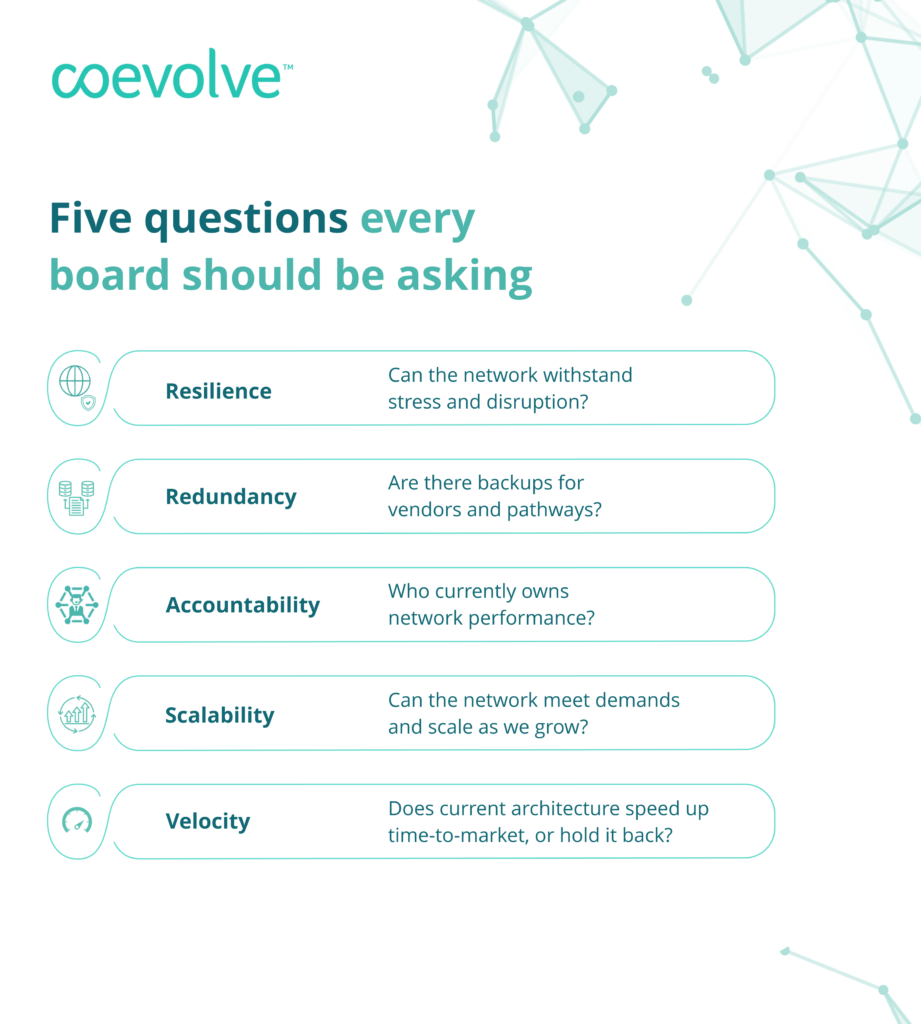
Enterprise leaders need to ask strategic questions about the resilience of their network connectivity to identify areas of improvement that can make real impact. These include questions like:
- How resilient is our current network against stresses and disruption?
- How much redundancy has been built into vendors and network pathways?
- Who currently has accountability for our current network?
- How well can the current network architecture support today’s demands and scale as the company grows?
- Does our current network help speed up time-to-market, or is it holding innovation back?
Why does network fragmentation affect the quality of AIOps?
Network fragmentation can create visibility gaps and operational silos, making it harder for AIOps platforms to correlate events, identify patterns, and prioritise risks accurately. When network data is spread across multiple tools, providers, and environments, organizations often struggle to gain a complete operational view, reducing the effectiveness of predictive insights and decision-making.
What is the future of enterprise network management?
The future of enterprise network management is predictive rather than reactive. As networks become more distributed across cloud environments, applications, users, and providers, IT teams need more than monitoring and alerts. Increasingly, organisations are turning to AIOps, automation, and operational intelligence to identify emerging risks, prioritise action, and address issues before they impact users or business services. Success will depend on combining resilient connectivity, unified visibility, and actionable insights to make faster, more informed operational decisions.
What does predictive network operations look like?
In practice, predictive network operations means identifying degradation before users notice it, understanding emerging risks before they become incidents, and prioritising operational responses based on business impact rather than alert volume.