

When network architecture becomes enterprise risk
- Coevolve
For decades, network security strategy followed a simple rule: build a strong perimeter. If a new threat emerged, organizations invested in another firewall, VPN, or security gateway. Success was measured by how effectively the organization could keep attackers outside of the network.
That strategy has since been turned on its head. The very measures that made perimeter-based network security so effective before are now the exact vulnerabilities in your infrastructure that attackers exploit first.
Today’s enterprises operate across cloud environments, remote workforces, third-party ecosystems, SaaS platforms, AI tools, and globally distributed applications. Data no longer resides behind a single perimeter, and neither do users.
Firewalls, VPNs, and security gateways are aggressively targeted precisely because threat actors know that once they’re in, they have free rein. Every unpatched perimeter device, outdated firewall, or network blind spot is an open door waiting to be used as an entry point. Gartner expects the volume of security vulnerabilities to exceed 1 million per annum by 2030.
Attempting to manage modern, hyper-distributed networks with a traditional fortress mentality is no longer viable and can be a major contributor to enterprise risk itself.
The accelerated obsolescence of traditional security models
Enterprise networks were built for a static, perimeter-bound world where users worked from corporate offices, applications resided in company-owned data centers, and security could be enforced at clearly defined network boundaries. Over the past decade, however, those assumptions have steadily broken down. First, cloud adoption moved applications and data beyond the traditional corporate network. Then hybrid work and distributed workforces blurred the distinction between internal and external users, making location an increasingly unreliable basis for trust. Now, a third wave is accelerating this transformation: the rapid growth of AI traffic that now carries proprietary code, customer data, and core IP information freely across networks with almost no inline inspection.
AI governance can barely keep up. 78 percent of enterprise users actively engage in “Bring Your Own AI” (BYOAI) in the workplace, bypassing formal IT oversight to plug personal AI tools into the office network.
What may seem like harmless AI use to the average worker – generating emails, summarizing reports, brainstorming ideas – is the catalyst for a much larger risk. Because so much AI activity in the workplace is happening without the IT department’s approval or governance, this “shadow AI” phenomenon poses clear risks to network security.
The most critical? Data leaks and regulatory exposure. Core intellectual property is constantly being exposed to third-party AI training pipelines and unvetted cloud infrastructures. 35 percent of sensitive data events involve proprietary source code; 27 percent involve confidential data such as financial information and internal strategy documents; and 15 percent of employees regularly violate data protection and privacy regulations to input customers’ personal data into unsanctioned AI tools.
Not to mention the threat posed by Agentic AI and Model Context Protocols (MCPs). By the end of 2026, 40 percent of enterprise applications will utilize agent-based architectures. If you thought standard AI chat interfaces already presented severe data-loss risks, imagine the risks associated with an autonomous AI worker that can roam freely across your network, read and write local files, execute code, and interface directly with corporate APIs.
In a world of high-volume, high-speed, cross-border data flows, the traditional network perimeter is already obsolete.
Building resilience into your digital infrastructure
The goal of a modern, resilient digital infrastructure isn’t to build a fortress that locks everyone out, but to create an adaptable foundation that enables secure business growth.
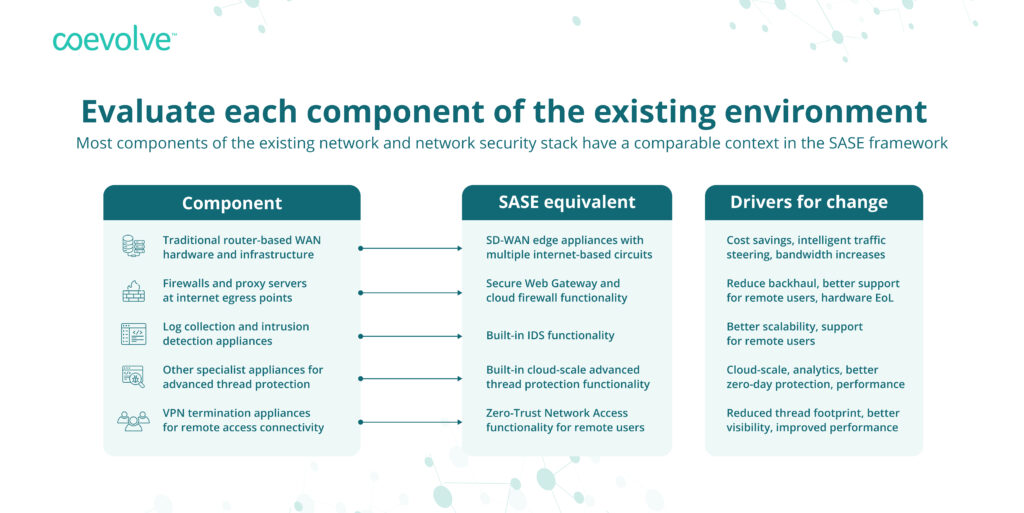
This is where Secure Access Service Edge (SASE) comes in. SASE provides a cloud-delivered framework that converges networking and security into a single, software-defined architecture. Instead of forcing organizations to continually modify firewalls, VPNs and network boundaries as the business evolves, SASE enables connectivity and security policies to be managed consistently across users, applications and locations, creating a more agile, resilient and scalable foundation for growth.
The business benefits can be substantial. One leading global business school achieved a 40% reduction in connectivity and security costs while improving cloud application performance by 60% after eliminating redundant legacy services, demonstrating that resilience, performance, and cost efficiency are no longer competing priorities.
Zero Trust Network Access (ZTNA) is a key capability within the SASE framework. Rather than granting broad network access once users pass a perimeter check, ZTNA continuously validates identity and context for every connection request. This replaces implicit trust with explicit verification, significantly reducing the risk of lateral movement and helping organizations contain security incidents before they spread.
Beyond security, SASE provides a foundation for operational resilience and business continuity. Because connectivity and security policies are abstracted from the underlying infrastructure, organizations can adapt more quickly to outages, cloud migrations, acquisitions, or changes in business requirements. Applications and users remain connected through a consistent policy framework, reducing reliance on manual network reconfiguration and enabling a more agile response to disruption.
Ultimately, resilient infrastructure is not simply about reducing cyber risk. It is about giving the business the ability to move faster. Organizations that embrace SASE can deploy new services more rapidly, integrate acquisitions more efficiently, support evolving AI initiatives more securely, and maintain continuity in an increasingly dynamic digital environment.
Boards need to change their risk perspective
The operational friction inherent in legacy networks is no longer just an IT problem; it’s a board-level risk. The fortress that once kept you safe is now keeping you stuck. When security infrastructure hinders the pace of business integration or cloud expansion, then the underlying architecture is fundamentally flawed.
Outdated network security carries very real financial consequences. Data breaches, operational downtime, and heavy regulatory fines are widely known consequences of what enterprises face when perimeters fail, but there is a more insidious cost: that of inaction.
As much as 80 percent of IT budgets go toward maintaining legacy hardware and systems, leaving very little left for innovation. Unsurprisingly, 88 percent of businesses view outdated networks as the very bottleneck limiting their growth. Organizations that fail to modernize their network architectures find themselves permanently bogged down by operational drag, continuously grappling with patching a leaky ship rather than forging ahead.
One of Asia-Pacific's largest automotive and industrial groups transformed its network across 19 countries, removing legacy MPLS dependencies to reduce connectivity costs by more than 40% while establishing an agile platform to support future acquisitions, expansion, and business transformation.
Instead of viewing network security as a check-box exercise in compliance, top-performing enterprises see building a secure and resilient infrastructure as its own competitive advantage.
- By decoupling cybersecurity from physical networks, the enterprise ensures legal compliance for geopatriation strategies and can now expand rapidly and securely across borders.
- By implementing SASE, security becomes a centralized, software-defined policy layer that highly adaptive and location-agnostic, freeing the enterprise from the operational drag of hardware bottlenecks.
- By deploying Zero Trust strategies, the enterprise protects itself against lateral movement attacks, while also removing the costly friction of traditional network redesign.
Security risk is financial risk
Most organizations don’t realize their network architecture has become a growth constraint until a major business initiative tests it. An acquisition exposes integration complexity. An AI program uncovers visibility gaps. A cloud migration reveals years of accumulated technical debt.
What appears to be a technology challenge quickly becomes a business challenge.
As cloud, distributed work and AI continue to reshape the enterprise, the organizations that succeed will be those that can adapt fastest. Increasingly, that ability is determined by the network underneath.
The question is no longer how well the network protects the business. It’s how much of the business the network is preventing
Is your network helping the business move faster or holding it back?
As cloud, distributed work, and AI continue to reshape the enterprise, many organizations are discovering that legacy network architectures have become a constraint on growth. Coevolve's SASE Readiness Assessment helps IT leaders identify architectural bottlenecks, evaluate operational risk, and build a roadmap toward a more resilient and scalable network foundation.
Table of contents



FAQs
Does SASE replace traditional VPNs and firewalls?
SASE replaces legacy VPNs and physical edge firewalls by moving connectivity and security inspection away from hardware appliances and into a unified, cloud-delivered architecture. Traditional VPNs are replaced by Zero Trust Network Access (ZTNA) to enforce least-privilege application access, while branch and perimeter firewalls are replaced by Firewall-as-a-Service (FWaaS). This allows SASE to eliminate latency bottlenecks, reduce ongoing hardware patching cycles, and remove the operational drag of manually maintaining physical network infrastructure.
How can we monitor AI traffic on our network without slowing operations?
Modern SASE architectures provide visibility into AI traffic without routing users through performance bottlenecks. Combined with Zero Trust, organizations can identify unsanctioned AI tools, monitor sensitive data flows, and enforce policies such as DLP in real time, enabling secure AI adoption without impacting user experience.
What is the real cost of not modernizing network security?
Key costs of not modernizing your network security include breach remediation, regulatory fines, and downtime. Yet the real cost is that legacy architectures bleed 80 percent of an enterprise’s IT budget keeping outdated hardware running, thereby limiting growth. With 88 percent of enterprises stating that their network is restricting growth, not modernizing security is a missed opportunity to innovate with M&As, market growth, and AI adoption. Enterprises must rethink modern security as a competitive edge; not simple loss avoidance.
How does resilient infrastructure improve business continuity during outages?
Resilient and robust infrastructure minimizes downtime during outages by ensuring business–critical systems remain up and running across the enterprise. Business continuity is maintained through key operational strategies such as redundancy, automated failover, and ongoing monitoring. Issues are resolved in the background while service availability continues in the foreground. Your enterprise can then bounce back quickly from disruptions and reduce the risk of customer dissatisfaction.