

From reactive to resilient: The operational advantage of AI-powered observability
- Coevolve
Baseline expectations for modern enterprise users have fundamentally changed. Seamless network performance and secure digital infrastructure are now considered bare minimum, and anything less than always-on is unacceptable.
Downtime can create huge upheavals for modern enterprises. And the pressure is on, with today’s end users expecting to access work resources anytime, anywhere. Whether it’s an enterprise platform, cloud repository, or business application, low latency and uninterrupted connectivity are the new normal.
At the same time, users have zero interest in the underlying complexity of a network that can scale across distributed teams and handle emerging AI workloads. That burden falls to the IT team—and with business complexities increasing, IT leaders have a tough road ahead.
This creates a timing gap for modern enterprises. While IT leaders carry full responsibility for service uptime and application performance, they frequently become aware of disruptions only after an end user submits a ticket, or a critical business operation has been impacted. This is a key issue, as slow response times can extend outages and recovery times, negatively impacting productivity and user experience.
Unfortunately, most IT leaders and network teams lack the real-time, end-to-end visibility and operational intelligence required to quickly isolate root causes, prioritize remediation, and maintain user experience across increasingly complex and disjointed environments. The consequences are extended troubleshooting cycles and prolonged Mean Time to Resolution (MTTR).
And when a root cause can’t be identified, teams are left with no choice but to patch the symptom rather than resolve the underlying issue. Meanwhile, the risk of disruption and performance bottlenecks continues to rise.
The core problem: continuous outages vs intermittent disruptions
A major driver of extended MTTR and user frustration is how different infrastructure issues manifest across enterprise networks. The most “visible” issues, like continuous outages, are caused by link or hardware failures. While dramatic, these are typically straightforward to detect. In properly architected infrastructures, automated failover protocols or secondary routing paths can quickly remedy the situation.
Far more insidious are intermittent disruptions or “gray” outages; a common occurrence that happens multiple times a week in IT, according to Interactive Australia. These “gray” outages are usually caused by transient packet loss, variable latency spikes, or subtle route flapping across cloud underlays. Because such micro-degradations rarely breach static thresholds, traditional monitoring tools often fail to generate alerts or provide the contextual insight required to identify emerging issues.
End users, however, experience severe application sluggishness or sudden dropped connections. Poor performance and delays trigger frustration, and users then call in to IT support or raise a ticket. But because these intermittent faults resolve spontaneously, and no observable data points stand out as red flags during the incident, network engineers can’t readily reproduce the issue for accurate diagnostics.
The consequences? These intermittent disruptions continue to occur. User experiences continue to erode, while the underlying root cause remains buried and unresolved.
Beyond downtime: the operational management side of infrastructure risk
Infrastructure risk is not just about the direct costs of downtime or the impact of outages on business performance; it’s also about the secondary vector of operational management risk.
Most leaders are aware of the primary operational risk of network fragility. The direct impact of even minor network disruptions is immediate and quantifiable, especially as enterprise workflows become increasingly digitized. The numbers paint a clear picture: the ITIC found that a single hour of unplanned downtime costs over $300,000, with 41 percent of enterprises estimating hourly downtime losses of up to $5 million.
What is less often spoken about is the operational management aspect of infrastructure risk. Modern networks sit across multiple cloud platforms, Software-Defined Wide Area Networks (SD-WAN), Security Service Edge (SSE) frameworks, and regional telecom underlays. Regardless of how organized existing setups may be, highly fractured or decentralized infrastructures pose distinct challenges and risks when it comes to effective operational management.
Specifically, IT leaders and network teams often encounter difficulties maintaining clear line-of-sight across complex, distributed environments. Visibility tools are often siloed across cloud, network, security, and application domains, forcing network engineers to navigate multiple disconnected dashboards to diagnose a single issue. And traditional monitoring tools generate high volumes of raw alerts daily, overwhelming engineers with alert fatigue.
Effective observability requires more than technology. It requires the operational expertise to interpret signals, identify emerging risks, and act before issues impact users. Learning, maintaining, and updating multiple platforms across an expanding and often fragmented infrastructure is a strain on engineers. Not to mention the challenge of ensuring 24/7 support coverage globally, and accelerated pressure to acquire the right resources and talent.
Today’s IT leaders feel the daily operational pain of tool sprawl, triage bottlenecks, and talent shortage. But network architecture investment often gets less airtime in the boardroom compared to high-visibility AI and customer-facing initiatives. Our Global Business Connectivity Outlook Report 2025-2026 found that almost half (45 percent) of technology budgets have been dedicated to AI investments, whereas only 8 percent is allocated for network architecture.
As we’ve seen before, AI performance is only as strong as the foundation carrying it. Addressing operational management deficits and closing the infrastructure investment gap is quickly becoming a strategic priority, particularly as organizations seek to scale AI initiatives that rely on predictable, high-performing network foundations.
You can't fix what you can’t see
When issue discovery relies on user escalation, IT leaders and network teams remain locked in a reactive cycle of firefighting, responding to issues rather than getting ahead of them. And when traditional monitoring stacks remain fragmented, valuable engineering sources are spent on tool maintenance rather than proactive risk reduction.
To move from reactive to resilient operations, enterprises require visibility. But visibility alone does not improve resilience. Organizations need the ability to understand what issues matter most, what business services are affected, and where action should be prioritized. Coevolve Smart Services provides this layer of operational intelligence, transforming technical data into business-aligned insights that support more informed decision-making and stronger operational governance.
Modern AIOps platforms can now process massive streams of telemetry across entire infrastructure footprints. This establishes historical performance baselines and recognizes even the most subtle deviations in jitter or traffic patterns. For example, our Smart Service Platform uses AI-powered correlation and inference across network, security, cloud, and operational data sources to identify patterns, anomalies, and emerging risks that may otherwise remain hidden. By connecting these insights to business context, Smart Services helps organizations understand not only what is happening across their environment, but also the potential operational impact and priority for action.
Smart Services provides a single operational view across complex multi-vendor environments. This enables faster decision-making, improved service assurance, and greater confidence that network and security investments are delivering intended business outcomes. Unlike traditional monitoring platforms that primarily generate alerts, Coevolve Smart Services combine AI-powered observability, automation, and expert operational oversight to help organizations proactively manage performance, resilience, and business continuity.
Transitioning from reactive to proactive observability
Lowering infrastructure risk and building operational resilience can be broken down into the following practical steps for observability:
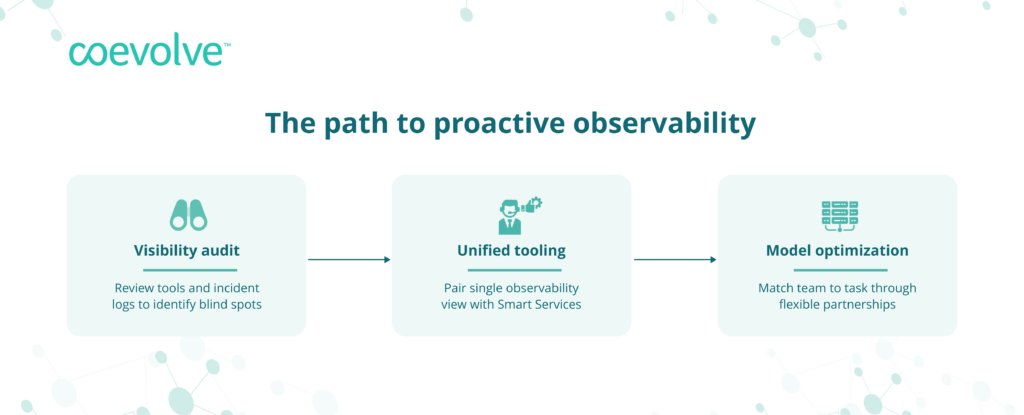
- Conduct a visibility audit
Map current monitoring coverage against your actual infrastructure footprint to identify blind spots. Review incident logs to quantify downtime costs and determine MTTR. Evaluate how observability incidents are currently identified, and the proportion of user-reported versus internally detected alerts.
- Consolidate tooling
Replace fragmented monitoring tools with a unified observability framework capable of monitoring multi-vendor architectures. Introduce vendor-agnostic Smart Services as a unified intelligence layer, correlating telemetry, performance data, service metrics, and operational insights across the entire infrastructure footprint. Establish performance baselines to identify anomalies, emerging risks, and opportunities for optimization before they affect business operations.
- Optimize execution model
Modernize operational support through flexible models such as strategic partnerships and co-managed frameworks. Decide what should be covered by internal engineering teams, and what can be entrusted to an experienced managed services partner. Continuously review operational models as technology requirements evolve.
IT leaders who prioritize business continuity must move beyond reactive monitoring and adopt a proactive approach to observability and infrastructure risk management. There is a reason we are told to fix the roof when the sun is shining. Building resilience requires organizations to identify emerging risks, close visibility gaps, and act before issues impact users or critical business services.
Book an infrastructure risk assessment to identify visibility gaps, uncover operational risks, and understand how Coevolve Smart Services can help turn observability data into actionable intelligence.
Table of contents



FAQs
How can I identify network issues before they cause an outage?
Organizations can reduce the risk of outages by adopting a proactive observability approach that identifies issues before they impact users or critical business services. This involves continuously monitoring network, cloud, security, and user experience data to detect anomalies, performance degradations, and emerging risks early. AI-powered analytics can help surface patterns that traditional threshold-based monitoring may miss, enabling teams to investigate and remediate issues before they escalate into service disruptions. Regular visibility audits and performance baselining can further help eliminate blind spots and strengthen operational resilience.
How can I improve visibility across my network infrastructure?
Improving visibility starts with gaining a unified view of performance across your entire technology environment, including networks, cloud platforms, security services, and end-user experiences. Many organizations struggle with fragmented monitoring tools that create data silos and operational blind spots. By consolidating observability data and applying AI-driven analysis, IT teams can better understand service dependencies, identify risks faster, and make more informed decisions. A visibility audit is often an effective first step in identifying coverage gaps and opportunities to improve operational insight.
How can I reduce Mean Time to Resolution (MTTR) for network issues?
Reducing MTTR requires more than faster alerts. Organizations need the ability to quickly identify the root cause of issues, understand their potential impact, and prioritize remediation efforts. AI-powered observability platforms can accelerate root cause analysis by correlating data across multiple domains, while automation can reduce the time required to resolve common issues. Combined with clear operational processes and expert support, this enables teams to respond more efficiently, reduce downtime, and maintain a consistent user experience.
How can AI help detect and resolve network issues?
AI can help organizations move beyond reactive monitoring by continuously analyzing vast amounts of operational and performance data in real time. It can identify anomalies, detect emerging risks, and uncover hidden relationships across network, cloud, security, and user experience data that may otherwise go unnoticed. AI can also support automated remediation and intelligent workflows, helping teams resolve issues faster and reduce manual effort. By turning complex telemetry into actionable insights, AI can enable IT teams to make faster decisions, strengthen resilience, and improve business continuity.