

Emerging Trends in SD-WAN, SASE, and Multi-Cloud Space
- Coevolve
The Convergence of SD-WAN and SASE: What It Means for Enterprises
Enterprise networking has undergone a fundamental transformation in recent years. What began as a shift toward cloud-first infrastructure has now evolved into fully integrated, cloud-native environments where networking and security are no longer separate functions, but part of a unified architecture.
Today, the drivers of this transformation are clear: hybrid work, multi-cloud adoption, and an increasingly complex threat landscape. Recent data shows that 67% of enterprises now operate hybrid work environments, reinforcing the need for secure, scalable, and high-performance connectivity.
This is where the convergence of Software-Defined Wide Area Network (SD-WAN) and Secure Access Service Edge (SASE) becomes critical.
SD-WAN solutions, first introduced to improve network performance and reduce reliance on traditional MPLS infrastructure, have delivered measurable benefits in cost savings and application performance. However, in previous years when enterprise environments became more distributed, it was evident that connectivity alone was not enough. In fact, to enable enhanced performance, experts realised that security needed to be embedded directly into the network as well.
SASE addresses this need by combining networking and security into a single, cloud-delivered framework. This convergence helps enterprises deliver secure, high-performance application access while reducing management complexity.
Today, over 65% of large enterprises are already using SASE components, with organizations increasingly consolidating networking and security into unified platforms. Rather than layering security on top of existing infrastructure, SASE integrates capabilities such as secure web gateways, cloud access security brokers, and Zero Trust Network Access into the network itself. This enables organizations to provide consistent security policies and user experiences regardless of location.
In 2026, the convergence between network and security functions, made evident by SD-WAN and SASE, is intriguing. Although SASE product offerings on the market are often all-inclusive bundles, many enterprises are not yet ready to make a total switch-over, despite being interested in some of the key benefits. Interestingly, many clients still desire separate networks and security architecture while others want SD-WAN without security, or new firewalls with the same network topology.
Architecture | Primary role | Key benefit |
SD-WAN | Connects users, sites, and cloud environments | Improved performance, resilience, flexibility and reduces cost |
SASE | Delivers secure access to applications from anywhere | Consistent security and user experience across distributed environments |
Multi-Cloud | Supports workloads across multiple cloud providers | Greater flexibility, scalability, and reduced vendor lock-in |
Potential IT Industry Repercussions and Adaptations
Coevolve was founded in 2014, and it wasn’t long after that we became a leading provider of next-generation WAN services. Since our formation, Coevolve has warmly embraced disruptive technology like SD-WAN and SASE. Hence, the convergence between these two technologies is significant to our solutions and underpins what we do.
Drawing from our expertise in the industry, when new technology or approaches emerge, we see high adoption rates from enterprises requiring such capabilities and ‘innovators’. Meanwhile, more modest enterprises require more information, use cases, and facts. Regardless of when enterprises accept the convergence between network and security, it’s the new networking norm.
A recent report from sdwan.au shows that 89% of businesses are expected to adopt SD-WAN by 2026, while SASE continues to scale rapidly, with the market projected to grow from $15.5 billion in 2025 to $44.7 billion by 2030 (23.6% CAGR). This notable growth reflects a broader shift from legacy infrastructure toward cloud-delivered, software-defined networking models to get ahead.
The convergence between network and security creates new uncharted waters, leading to enterprises looking beyond big vendors to niche solution providers like Coevolve.
That’s why we specialize in co-managed solutions that enable enterprises to maximise full network transparency while delivering premium services with added value. Demand for co-managed models continues to grow as organizations seek alternatives to traditional outsourced arrangements, particularly as many telecommunications providers scale back their managed services focus and concentrate on core connectivity offerings. At Coevolve, we’ve seen this shift first-hand and help enterprises achieve the flexibility, visibility, and operational control they increasingly require.
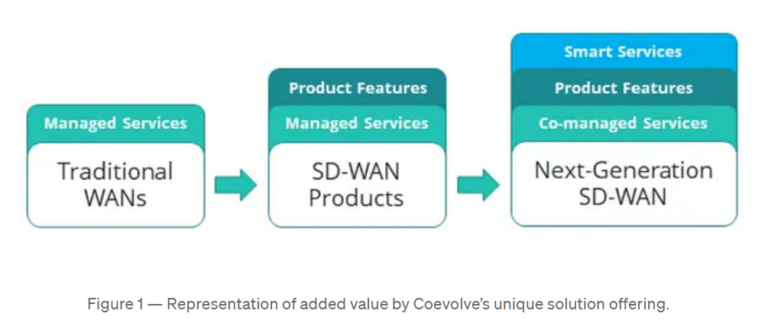
Coevolve's unique solutions incorporate 5G, AI, and Automation: Transforming SD-WAN and SASE
A big component of the network life cycle is optimization. Enterprises are continually looking to identify new ways to optimize their network environment performance and lower cost.
At the same time, providers are starting to engage with 5G and Artificial Intelligence (AI) to further enhance their offerings. Providers are incorporating 5G to further expand on SD-WAN’s capabilities, as well as integrating AI to support the mass influx of metadata from contemporary network architectures.
Although it’s uncertain when these technology enhancements will be in offerings, it only takes one provider to bring it to market for the domino effect to occur. So, the real question is, who will offer it first?
At Coevolve, we continuously strive to offer our clients innovative solutions. So, we were very proud to announce the launch of our Smart Services earlier this year, leveraging powerful automation to produce new network monitoring and management capabilities. Coevolve Smart Services dips into how automation can be used within the networking industry. In time, we hope to expand on our Smart Services and further elevate our solutions for clients.
The Future of SD-WAN, SASE, and Multi-Cloud Environments
As enterprises continue to adopt multi-cloud strategies, the need for seamless integration across platforms is increasingly important. Whether enterprises are adding to or implementing new network architecture, SD-WAN is the top choice to expand the number of locations with light edge appliances, with the addition of SASE to secure the network edge.
There’s potentially more to come from SD-WAN as well, as the software-defined principles it’s based on are applied to other components of IT infrastructure. For example, we’ve seen a steady increase in the SD-Branch architecture, which applies orchestration, centralized profiles, and end-to-end visibility to other components of the branch infrastructure, including LAN and wireless. The operational efficiencies that can come from this streamlined model mean we are likely to see more of this approach in the coming years.
Considering SASE is new to the industry, we expect vendors to do significant work on their offerings, generating new methods of adoption, increased capabilities, and higher performance.
SASE will likely remain in the spotlight for years to come. Additionally, we expect to see SASE adoption rates plateau, as many enterprises quickly adopted SASE, overlooking optimization and associated costs to ensure the business operations remained viable in light of the pandemic. Thus, we will see another shift in enterprise focus: a move from SASE adoption to optimization — increasing performance and cost savings for the future.
Key Takeaways
- SD-WAN and SASE are converging into unified cloud-native networks, with 65% of large enterprises already using SASE components.
- Hybrid work (67%) and multi-cloud growth are driving demand for secure, scalable networks with built-in security.
- SD-WAN is expected in 89% of businesses by 2026, while SASE will grow to $44.7B by 2030.
Table of contents




FAQs
What is the difference between SD-WAN and SASE?
SD-WAN focuses on optimizing network connectivity and performance, while SASE combines networking with integrated security services to provide secure, cloud-delivered access across distributed environments.
Why are enterprises adopting SASE?
Enterprises are adopting SASE to simplify their infrastructure, improve security with Zero Trust models, and support hybrid work with consistent access across users and locations.
Does SASE replace SD-WAN?
Not necessarily. Many SASE solutions incorporate SD-WAN capabilities as part of the broader architecture, combining network optimisation with cloud-delivered security and access controls.
How does SASE support multi-cloud environments?
SASE provides centralized security and policy enforcement across multiple cloud platforms, ensuring consistent performance and protection regardless of where applications are accessed from.