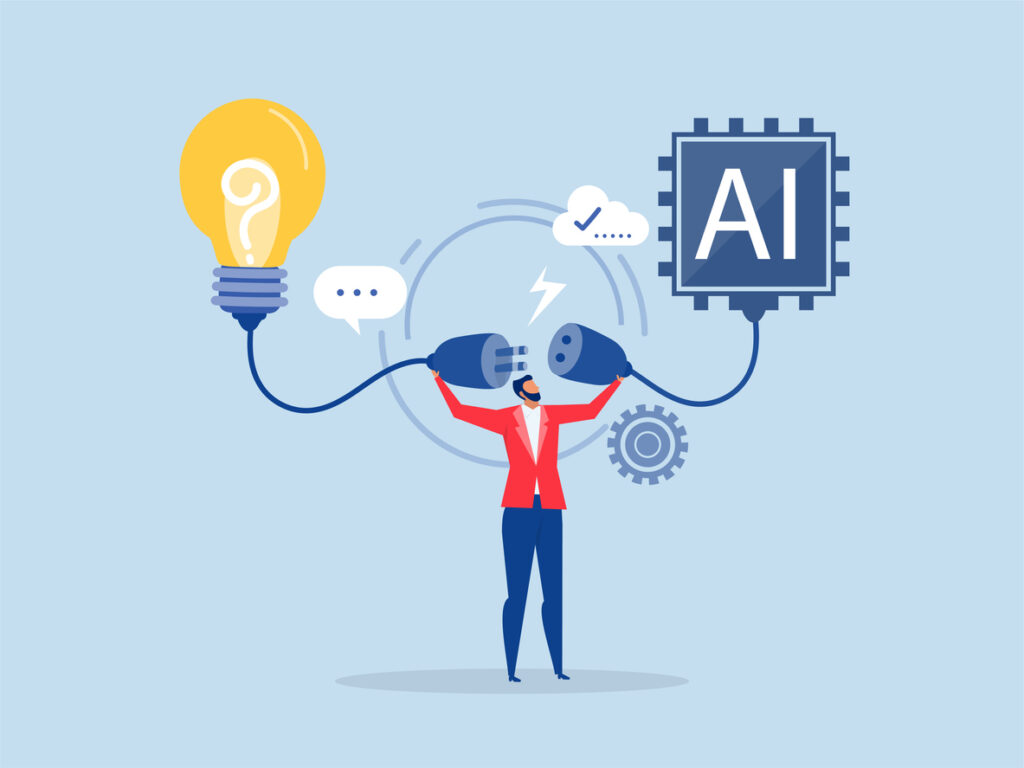

Your AI strategy is only as strong as the network behind it
Why autonomous AI is changing the demands on global enterprise infrastructure
At the AI Transformation Forum in Singapore recently, one thing stood out to me. The confidence enterprise leaders have in AI is growing rapidly. However, I’m less convinced the same confidence exists in the infrastructure required to support it ubiquitously. And the challenge is about to become more complicated as AI is changing who, or what, uses the enterprise network.
AI is firmly on the executive agenda. Organisations are investing heavily, exploring new use cases and looking for opportunities to improve productivity and change how work gets done.
Yet McKinsey’s State of AI 2025 research points to an interesting disconnect. While 88% of respondents say their organisations use AI in at least one business function, only 7% report having fully scaled it across their organisations.
There’s clearly a considerable distance between experimenting with AI and embedding it into everyday business operations. I suspect some of the obstacles to closing that gap are receiving less attention than they deserve.
AI is changing who, or what, uses the network
Until recently, most of us experienced AI through a fairly straightforward interaction. A person asks a query, the model responds, and the process ends. Agentic AI changes that dynamic. An AI agent can initiate multiple activities, interact with different applications, retrieve information, make decisions and trigger further actions, often with little human intervention.
The scale of this change is now becoming apparent. Recent analysis published by Andreessen Horowitz, using data from OpenRouter, shows AI agents consuming nearly five times as many tokens as direct human usage on the platform. Agentic token consumption increased fourteenfold between February and August 2026.
OpenRouter represents only one part of the AI ecosystem, and token consumption shouldn’t be confused with network traffic. Nevertheless, the trend is hard to ignore.
For decades, much of enterprise networking has focused on connecting employees and locations to the applications they depend on. Nowadays, networks must also support autonomous agents and systems interacting continuously, often without a person directly involved. That’s a fundamental change in what we’re asking enterprise infrastructure to do.
Consider an employee using a chatbot. If the response takes a few extra seconds, it’s usually an inconvenience. If the service becomes unavailable, the employee can often return to the task later.
Now consider an autonomous agent coordinating part of a supply chain, processing transactions or supporting production decisions. Its performance depends on access to multiple applications, data sources and services, potentially distributed across different continents and cloud environments.
A failure in one of those dependencies could interrupt the entire process. Worse, an agent might continue operating with incomplete or outdated information, producing consequences that aren’t immediately obvious.
As enterprises become more dependent on AI-driven workflows, infrastructure reliability, security and visibility take on greater business significance.
The infrastructure hasn't necessarily kept pace
Cisco’s 2026 AI Readiness Index found that only 15% of surveyed organisations had networks fully ready for AI.
Enterprises have spent years modernising applications, migrating workloads to the cloud and transforming cybersecurity. Many have also invested heavily in network transformation. But those investments weren’t necessarily designed around the demands of increasingly autonomous AI workloads.
We’ve seen this disconnect before. When enterprise applications began moving rapidly to the cloud, many organisations were still operating networks designed primarily to connect offices and data centres. Architecture lagged the changing application environment.
As security became cloud-delivered, traditional network and security operating models also needed to evolve. AI represents another significant change in what enterprise infrastructure is being asked to support. My co-founder, Ciaran Roche, recently explored this from a technical perspective, examining how AI changes traffic patterns, performance requirements and network operations.
The broader business implication is equally important.
AI readiness needs to be assessed across the entire technology environment. Network performance and resilience matter, alongside security, identity, cloud architecture, data accessibility, observability and the processes used to manage them.
The real test is whether those components work together reliably when AI moves from isolated applications into everyday business operations.
Global enterprises face a more complicated challenge
One thing I’ve learned from a few decades providing enterprise network operations across over 80 countries is that the architecture on a Visio network topology diagram rarely captures the complexity of what happens on the ground. Multinational enterprises operate across different telecoms markets, regulatory environments, cloud platforms and security architectures. Some locations have excellent connectivity and multiple resilient options. Others depend on a limited number of local providers, with varying performance, reliability and support capabilities.
There are also years of accumulated technology decisions to contend with. Acquisitions introduce different systems. Regional teams adopt different platforms. Security policies evolve, sometimes inconsistently. Applications move to the cloud, but not always in a coordinated way.
Now introduce AI agents that need to interact with business systems across that environment. A multinational manufacturer might use AI to coordinate inventory, production scheduling and supplier management across plants in several countries.
The AI application could be exceptionally capable, but its effectiveness depends on reliable access to information and systems throughout that distributed environment. When a process fails, identifying the cause may be far from straightforward. A local connectivity issue, security policy, application problem or cloud dependency could all produce similar symptoms.
The business sees a failed process. The underlying cause might involve several technology domains and external providers.
AI also introduces a different risk. When people are performing these activities, they often recognise when information looks wrong or a process isn’t behaving as expected. Autonomous agents may continue executing instructions until a problem is detected by another system or control. That places greater importance on end-to-end visibility, well-defined permissions and the ability to intervene when automated processes behave unexpectedly.
AI governance needs more than policies
Research from Cato Networks, based on a survey of more than 600 IT leaders, found that 69% lacked a formal system for monitoring AI adoption. That’s concerning given the speed at which AI is being introduced into organisations.
Many enterprises are developing AI governance frameworks, establishing acceptable-use policies and considering how to manage data privacy, security and regulatory exposure. All necessary steps.
But effective governance requires an understanding of what’s actually happening across the environment. Which AI services are employees accessing? What information is being exchanged? Which applications are interacting with external models? What permissions do autonomous agents have, and how are those permissions enforced?
These are becoming operational questions, not simply policy decisions.
At the Singapore Forum, I made the observation that the network is where AI governance stops being a policy and becomes enforceable.
Network security alone cannot solve AI governance. Identity, application security, data protection and AI-specific safeguards all have essential roles. But without visibility and enforceable controls across the underlying infrastructure, governance frameworks risk being disconnected from everyday activity.
For multinational enterprises, consistency becomes particularly important. A policy established at headquarters has limited value if it cannot be applied and monitored effectively across different countries, platforms and business units.
The operating model deserves just as much attention
There’s a recurring theme across my earlier articles in this series: technology capability and the ability to consistently deliver business outcomes are two different things. This is all yet to fully play out, but I think AI reinforces that distinction.
Most large enterprises have specialists managing their networks, cybersecurity, cloud platforms, applications and data. That expertise remains essential. The difficulty is that AI-enabled business processes increasingly depend on all these domains working together.
An autonomous workflow might access data in one environment, invoke a model in another, interact with an enterprise application and initiate a transaction elsewhere. When something goes wrong, resolving it may require coordinated investigation across multiple teams and providers.
Traditional operational boundaries don’t always make that easy.
Enterprise leaders need to consider how responsibilities are organised, how visibility is shared and how incidents are managed. This doesn’t necessarily require another major restructure. Better integration between existing teams, clearer accountability and well-designed automation may deliver far more value. The same applies to external technology partners.
As enterprises adopt more sophisticated AI capabilities, the ability to orchestrate complex infrastructure and security environments becomes increasingly important. Specialist expertise, operational knowledge and the ability to work across different platforms will matter more than simply owning or supplying individual components.
The operating model needs to evolve alongside the technology, rather than being reconsidered after problems emerge.
Three questions worth asking now
I wouldn’t advocate slowing AI adoption until every element of enterprise infrastructure is perfect. That isn’t practical, and organisations need to experiment, learn and move forward. But I’d encourage CIOs and their executive colleagues to give three areas more attention.
- First, visibility. Do we have a sufficiently clear picture of AI activity across our organisation, including services and agents operating outside formally approved platforms?
- Second, readiness. Have we assessed our network, security and cloud environments against the AI workloads we expect to operate in production, rather than simply those we’re experimenting with today?
- Third, accountability. When an AI-enabled business process fails, do we have the visibility, expertise and operational coordination to identify the cause and restore service quickly?
These are practical considerations, but they also affect the return organisations can expect from their AI investments.
A reflection in closing
I have little doubt that AI will fundamentally change how enterprises operate. We’re already seeing impressive progress, and the transition towards autonomous systems is happening faster than many anticipated. But I suspect we’ll look back on this period and find that the biggest differentiator wasn’t access to the latest AI models or the number of pilots underway.
It was the ability to integrate AI into the everyday operations of a complex business, reliably and securely, across every location where that business operates. The next phase of enterprise AI will test something beyond the sophistication of the models themselves.
It will test whether the infrastructure, security and operating models supporting them are fit for a world where machines increasingly carry out business-critical work.
That’s where I believe the next competitive advantage will be found.