

Secure connectivity: the new mandate for manufacturers in 2026
- Coevolve
In the Industry 4.0 or ‘Fourth Industrial Revolution’ era, modern manufacturing is an entirely different-looking industry to days gone by. Factories are highly distributed, digitized, automated, and data-dependent. Everything in a smart factory is interconnected, from plants to warehouses, suppliers, cloud platforms, enterprise resource planning (ERP) systems, Internet of Things (IoT) environments, security platforms, remote teams, and the list goes on. In addition, with data constantly flowing across these environments, connectivity is now more than an IT infrastructure issue: it’s a mission-critical priority.
While connectivity is the backbone of modern manufacturing, it’s a term that’s often overlooked and misunderstood across leadership. Achieving the connectivity needed to support the complex interconnected operations of modern manufacturing adequately is not only an operational resilience requirement but an enabler of business growth. Yet, in today’s digital age, IT leaders are struggling to know how to ensure secure connectivity to get ahead.
Connectivity is the new business capability
According to our latest manufacturing edition of the Global Business Connectivity Outlook Report 2025-2026, there is a growing connectivity gap taking place among global enterprises. The manufacturing sector is grappling with unique pain points stemming from its more complex, distributed, and data-heavy environments. And these pain points are resulting in connectivity being overlooked at the top.
This gap is risky for executives, as secure connectivity is the new business capability that affects everything from operational resilience to cyber risk, production continuity, cloud adoption, supply chain visibility, and effective digital transformation. To truly succeed with AI and automation in the long-term, it’s connectivity that must be the top boardroom priority – ahead of technology implementation itself.
Given that leadership fatigue is becoming more prevalent – with nearly 70 percent of C-level executives at risk of burnout – competing priorities are contributing to limited connectivity conversations in the boardroom. That’s why leaders need to know that connectivity isn’t simply “the network”; it’s the business’s ability to operate in today’s digital age and connect people, sites, systems, machines, applications, partners, and data securely and reliably.
Educating and engaging executives is key to bringing them along on the journey of understanding. Going forward, it’s important to help leaders measure the benefits that connectivity delivers against business goals and outcomes. Getting the balance right is the new superpower in business capability.
What happens if connectivity fails?
In this new digital era of manufacturing, if connectivity fails, the results can be disastrous. Gartner reveals that 82 percent of companies have experienced at least one unplanned downtime incident in the past three years, leading to financial losses, disruption, and reputational damage. Further industry research shows that companies with frequent outages experience 16x higher costs than those prioritizing operational resilience.
When connectivity fails, the impact is rarely just technical. In manufacturing, failures affect production, security, compliance, customer delivery, and executive confidence in digital transformation, with direct and damaging business consequences. From production delays to supply chain disruption, remote access issues, and customer fulfilment risks, it’s best to avoid these risks before they happen.
To avoid such connectivity failures, manufacturing IT leaders must first ask: which business processes are dependent on secure connectivity? What is the consequence if that connectivity is degraded, interrupted, or compromised? Connectivity must not take a backseat – it needs to be front and center.
Mind the gap: elevating the secure connectivity conversation first
While our report found that 75 percent of manufacturing leaders believe connectivity needs to be discussed at the executive level, 22 percent report that it’s only occasionally discussed in the boardroom. Many manufacturers are yet to fully incorporate connectivity into their digital adoption strategies and underlying architecture, leading to a higher risk of downtime if connectivity fails.
With research showing that downtime costs have risen by 400% since 2018 in the UK, mitigating the risk of downtime is vital to future business growth. Yet, among the manufacturing leaders we interviewed, compliance, technology, and security were the top three challenges keeping leaders awake – not downtime or connectivity disruptions.
Our research finds that connectivity impacts daily business operations at every level. Whether it’s production uptime, site availability, and supply chain coordination – or access to ERP and the manufacturing enterprise system (MES), cloud, and seamless Software-as-a-Service (SaaS) platforms – connectivity underpins it all and enables higher performance.
Translating complex concepts into simple language for the C-suite is imperative – but this opportunity is being missed as an initial step in digital transformation. By taking this important first step, IT leaders can reduce the gap between the critical role of connectivity and its limited visibility in the boardroom.
Further, just as importantly as engaging the C-Suite on connectivity, it’s critical to engage the frontline workers. Our data suggests that this isn’t happening, with 25 percent of manufacturers surveyed saying that there is zero visibility of the connectivity conversation in their organization. Key people and teams are being excluded from the connectivity conversation, increasing vulnerabilities in security posture, with a heightened risk of failure for even the most innovative manufacturers today.
Reframing connectivity as a component of operational resilience
To remain competitive in Industry 4.0, connectivity must be reframed. Connectivity is directly linked to operational resilience, meaning that after bringing connectivity into the boardroom, leaders must give secure connectivity its rightful place as part of their broader operational resilience framework.
To achieve this, leaders will need to identify which sites, systems, processes, and data flows are most important to the business. Connectivity strategies can then be designed accordingly, forming a robust foundation for AI and digital transformation and upscaling.
Securing boardroom visibility is also key to mobilizing the interdisciplinary board-level expertise needed to best align investment with impact. As part of this process, leaders should avoid unnecessary over-engineering or over-investment. Through this strategic approach, manufacturers can ensure highly secure connectivity and promote risk strategies that are adaptable across diverse locations and sites.
As manufacturers apply this approach and build more robust connectivity frameworks, they need to take note that robust network foundations and secure connectivity must occur ahead of AI adoption. This is because digital transformation in manufacturing is only as strong as the connectivity that underlies it.
Rather than being the focus of the IT agenda and budget, AI should ideally be the springboard for innovation, with solid connectivity and network foundations underpinning it. The C-suite can then feel confident in their approach to operational resilience. They can get AI-ready with initiatives built out strategically, not through fragmented thinking that prioritizes AI over secure connectivity.
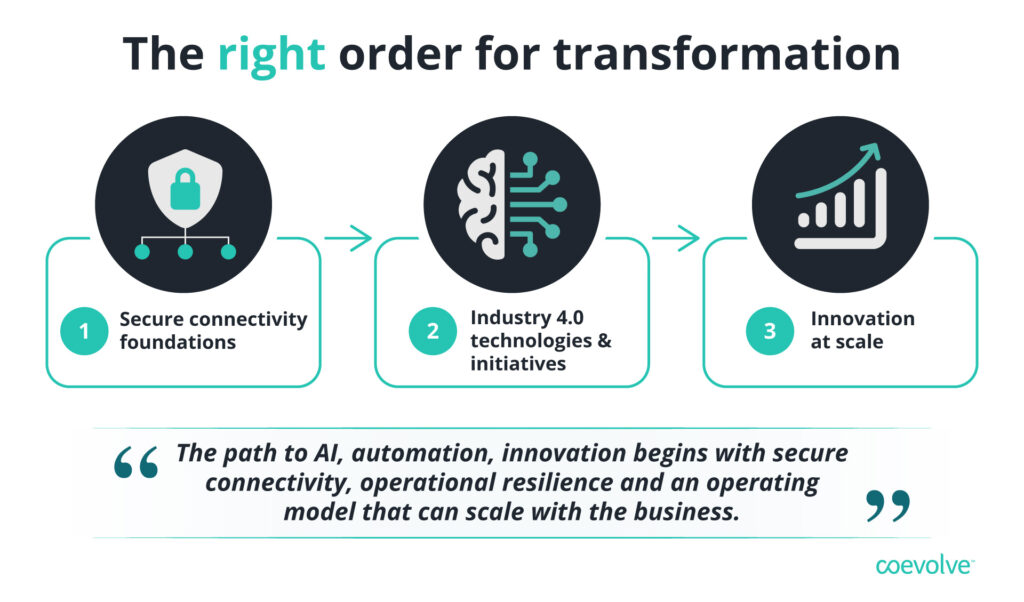
3 things to note before implementing secure connectivity in your manufacturing business
- Standardize before you scale: Many manufacturers have connectivity environments shaped by acquisitions, regional decisions, local provider relationships, legacy designs, and tactical fixes. What standardization realistically looks like for a global network will vary depending on business needs – but the universal truth for manufacturers is that they must avoid scaling transformation on top of a fragmented or broken foundation.
- Embed connectivity into transformation initiatives. Connectivity is often considered too late and too narrowly. A manufacturer may start a cloud migration, ERP rollout, smart factory program, OT security project, AI initiative, or acquisition integration, and later discover that the connectivity model isn’t ready for digital transformation. That creates costly delays and overruns, performance issues, and security gaps. Connectivity must therefore be rooted into transformation initiatives from day one.
- Make connectivity measurable for your business. AI adoption is only as strong as the foundation underpinning it. To build more seamless operations, secure connectivity must be the first step in AI readiness. Traditional measures like uptime and bandwidth utilization are useful, but they don’t measure business impact. To truly make connectivity measurable, look at performance, resilience, and business readiness first. If connectivity isn’t measured, it will be invisible until it fails. Plan ahead to stay ahead.
Scale successfully with secure connectivity
Underestimating the value of connectivity is a common – and costly – mistake for today’s enterprises. And overlooking secure connectivity leads to fragmented decisions, inconsistent security, poor visibility, and transformation programs that assume the network will simply cope, not thrive, in Industry 4.0.
To innovate and scale successfully in 2026 and beyond, secure connectivity must be reimagined at every level. Secure connectivity is the new mandate for modern manufacturers: the backbone that will help manufacturers scale and succeed in the long-term. The IT leaders who help to close the connectivity gap in the boardroom will be the ones who effectively guide their enterprises through this new age of AI.
Table of contents




FAQs
What does secure connectivity mean for manufacturers?
Secure connectivity for manufacturers means designing and implementing robust infrastructure that balances existing operational needs with AI-led innovations and systems implementations. Secure connectivity aims to reduce the risk of exposure to threats and safeguard against issues such as downtime, data loss, and cyber-attacks that could disrupt operations.
What is Industry 4.0?
Industry 4.0, or the ‘Fourth Industrial Revolution’ is a new way of working in manufacturing. It integrates advanced technologies like AI and cloud computing to enhance automation, production efficiency, and data-driven decision-making across manufacturing processes. Industry 4.0 is resulting in the rise of smart factories that optimize supply chains and improve the overall productivity, flexibility, and scalability of the sector.
How can Coevolve help manufacturing IT leaders?
Coevolve helps manufacturing IT leaders prepare for Industry 4.0 via a secure connectivity approach. Coevolve partners with enterprises to provide innovative solutions and cutting-edge technology that optimizes operations, enhances productivity, and streamlines workflows. The company’s expertise in next-generation network and security technologies supports manufacturers in overcoming challenges related to digital transformation and disruption.