

Infrastructure resilience is a people problem: the role of co-managed services
- Coevolve
IT infrastructure was once a data center, a few private circuits, and a sense of predictability. Those days are gone. Today’s infrastructure must support cloud-first architectures, distributed users, evolving security requirements, and the growing demands of AI. While next-generation networking and security technologies create new growth opportunities, they also introduce a level of operational complexity that many teams struggle to manage.
But fast also means that technology advancements are now outpacing the teams responsible for operating it.
For a long time, infrastructure risk and enterprise resilience were evaluated almost exclusively through a technological lens. How strong is our component redundancy? What is the mean time between failures? Do our firewall configurations and carrier-level Service Level Agreements (SLAs) meet requirements?
That’s no longer where the real exposure sits. While organizations continue to invest heavily in resilient infrastructure, many are discovering that technology is no longer the primary constraint. Increasingly, operational capability, including the skills, capacity, and expertise required to manage complex environments, has become a significant source of infrastructure risk, shifting IT leaders to a new question: do the people managing your systems have the bandwidth and skills necessary to keep up with the technology?
Who’s supporting the support teams?
When internal engineering teams are overwhelmed by operational overhead, enterprise risk escalates. Constant configuration updates, continuous patch cycles, multi-vendor escalations, alert fatigue, and ever-changing compliance checkboxes are stretching teams thin, especially in the new operational reality of AI.
Burnout and on-call strain have become very real threats to enterprise resilience. The inability for human skills to keep pace with an infrastructure that gets more complex every year is causing vulnerabilities to multiply. And when people’s capacity and capability cannot keep up with technological complexity, cracks show up everywhere at once. Support response times slow, transformation projects stall, and key-person dependencies mean entire operations can crumble if one individual becomes unavailable.
What makes this even more dangerous is that the warning signs are often easy to overlook. Infrastructure performance may appear healthy on a dashboard while operational strain quietly builds behind the scenes, creating risks that only surface once service levels, security, or transformation initiatives are impacted.
A security alert gets acknowledged but is not fully investigated because there is no time to dig in. Firmware upgrades and security patches are pushed to the next window, but that next window never comes. Change documentation gets skipped in favor of a more pressing deadline, resulting in knowledge loss. Senior engineers get pulled into every escalation, even for the most basic operational tasks.
For enterprises, this isn’t an issue that can be resolved simply by expanding headcount. Onboarding a new senior infrastructure engineer still leaves a gap in immediate baseline productivity, which heightens operational risk and cascades delays across other corporate initiatives. And that’s assuming hiring moves quickly and smoothly. Talent scarcity is most severe in the Information industry, according to ManpowerGroup, and difficulty rises with organization size. 75 percent of the largest businesses report trouble filling roles, against 64 percent of smaller firms.
Infrastructure resilience is a people problem
Skills deficits and wider macroeconomic pressures have made talent shortage a key bottleneck to business growth. ACS Australia’s Digital Pulse 2025 highlights a significant imbalance in talent availability. 150,000 Australian businesses report significant to severe gaps in digital capability, and it’s restricting how quickly they can expand.
The demand is particularly acute for specialized professionals in infrastructure, operations, and cybersecurity. It’s projected that the national demand for ICT management and operations roles will grow at a rate of 5.3 percent annually: a rate that conventional talent pipelines cannot match. 51 percent of the general workforce already say they are missing at least one digital skill required for their job. Zoom in to technology roles specifically and that number jumps to 77 percent. Clearly, people are feeling overwhelmed and underprepared to keep pace with technology.
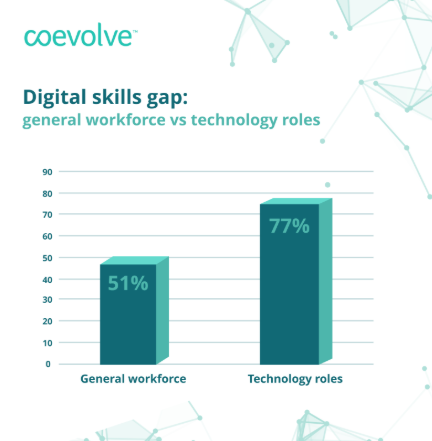
This is a resilience problem because the biggest risk to modern infrastructure is often not a technology failure, but an operational capacity failure. As networks, cloud environments, security controls, and AI-driven workloads become increasingly complex, teams are being asked to manage more with the same resources. The result is growing operational strain, increased risk, and a higher likelihood of mistakes. In fact, 57 percent of organizations attribute a quarter of their reliability incidents to human error. Even well-designed environments become vulnerable when organizations lack the skills and capacity to support them effectively.
How capability partnerships and co-management models bridge the gap
IT leaders understand the importance of building redundancy in hardware and software layers. But what about redundancy in the people layer?
Traditional talent models are becoming increasingly fragile. Linear hiring pipelines assume that you can predict what skills you’ll need, hire for them, and then have that person productive before the need shifts again. This assumption held when infrastructure environments were still static. In the new reality of distributed, software-defined environments, however, it’s become a source of vulnerability.
Legacy outsourcing models aren’t the answer either. It solves the capacity problem by handing over whole IT functions, but fully outsourced arrangements introduce their own rigidity in the form of slow response times, vendor lock-in, and loss of control. In solving key-person dependency, they risk creating dependency on a single provider instead.
Organizations increasingly need a model that provides access to capability without sacrificing control. Co-management bridges the gap between building every capability internally and outsourcing operations entirely. Enterprises retain strategic ownership and control while a co-managed partner provides the operational scale and specialist expertise needed. They do this by:
Protecting core personnel by reducing operational burnout
The most effective co-managed partners augment internal teams with additional operational coverage, helping organizations manage monitoring, telemetry analysis, and incident response across increasingly complex environments. When alert volumes spike or major transformation initiatives place additional pressure on internal resources, this added capability helps maintain operational stability and service performance.
Elevating internal skills through cross-pollination
Beyond providing additional capacity, co-managed models create opportunities for knowledge transfer and capability development. Access to specialist expertise across areas such as SASE, multi-cloud networking, security, and infrastructure operations helps internal teams strengthen skills through real-world collaboration, not just formal training.
Over time, this shared operating model helps organizations build internal capability while keeping pace with evolving technologies and increasingly complex infrastructure environments.
Preserving strategic authority and oversight
With co-management models, strategic and architectural control remains internal. IT leaders stay in the driver’s seat when it comes to policy governance and roadmap prioritization. Internal engineers maintain continuous visibility over operations, as they see the telemetry, sit in on the escalations, and retain decision-making authority, while the partner absorbs the execution underneath. This way, organizations achieve operational relief without surrendering control or line of sight.
Most enterprises still register “infrastructure risk” and “talent risk” as separate lines, but in reality, they are deeply connected. The resilience of modern infrastructure depends not only on how it is designed, but whether the organization has the operational capability to support it effectively.
Under-resourcing the operational model, including the staffing, tooling, and support structure around your engineers, is one of the biggest dangers to enterprise resilience. Turnover, skills gaps, and knowledge loss compound into infrastructure risk because when internal teams are stretched beyond their capacity, response times slip, security coverage thins, and roadmaps stall.
The real question leaders should be asking isn’t whether they have enough good engineers, but whether they have built an operating model that lets good engineers keep up with what they’ve been asked to run. If there is a gap, co-managed services offer the human capability, operational coverage, and organizational agility needed to break through the barriers holding businesses back from sustainable growth and innovation.
Table of contents

FAQs
How can I address IT skills shortages without increasing headcount?
As infrastructure environments become more complex, many organizations are finding that recruitment alone cannot close capability gaps fast enough. A co-managed services model provides access to specialist expertise and operational support when needed, allowing organizations to scale capability, reduce pressure on internal teams, and maintain operational resilience without continually increasing headcount.
How can I provide 24/7 IT support with a limited internal team?
A co-managed services model enables organizations to extend operational coverage without requiring round-the-clock internal resources. Depending on the capabilities of the provider, this can include monitoring, incident response, operational support, and access to specialist expertise outside normal business hours.
The benefit is not simply greater coverage, but improved resilience. Internal teams can focus on strategic priorities while maintaining confidence that emerging issues are identified and addressed before they affect users and business operations.
When should I consider co-managed IT services?
You should consider co-managed IT services when maintaining, securing, and evolving your infrastructure is consuming more time and resources than your team can sustainably support. If operational demands are growing, specialist skills are difficult to source, or strategic projects are being delayed by day-to-day support activities, it may be time to augment your internal capabilities.
The right co-managed partner helps reduce operational risk by providing access to specialist expertise, additional capacity, and broader operational coverage, allowing your team to focus on strategic priorities while maintaining control of technology decisions and business outcomes.