

Reframing resilience: why infrastructure flexibility is the foundation for resilience
- Coevolve
As a senior IT leader, ask yourself the following:
If your organization decided to accelerate AI adoption tomorrow, could your infrastructure support it at scale?
If you were expanding into new markets, could applications, users and data be delivered with consistent performance across regions?
If your business needed to launch a new digital service or SaaS offering, could your technology environment adapt without major redesign?
For many leaders, at least one of those answers is “not yet”. It’s not a sign of bad decisions; it’s what naturally happens when an architecture built for yesterday’s priorities must now meet tomorrow’s demands.
Enterprise infrastructure investments have historically been driven by short-term capacity planning. Hardware and networks were provisioned to satisfy current-state application needs, and budgets were optimized around project-specific cycles and point-in-time assumptions.
But in the modern reality of continuous digital disruption, quickly evolving operations, and accelerating AI workloads, this short-term approach to network infrastructure planning has become a significant business risk. Environments that were once architected exclusively for today’s requirements inevitably end up placing constraints on future expansion, agility, and recovery. Rather than supporting acceleration, inflexible legacy stacks have instead become a barrier, forcing organizations to adapt their business strategies around infrastructure limitations.
And the financial implications are real. According to Gartner, 60 percent of AI initiatives will be abandoned in 2026 due to unready infrastructure and fragmented data. McKinsey found that organizations end up spending 20 percent more per project than expected due to underlying architectural issues. Additional research by Colt found that 67 percent of businesses encountered missed opportunities due to limitations in their digital infrastructure.
The challenge is no longer access to technology. It is whether the underlying infrastructure can keep pace with what the business demands from it.
Architecture decisions made today set the ceiling for tomorrow’s business growth. The organizations best positioned to capitalize on AI, expansion opportunities, and new digital business models will be those that have built infrastructure designed to adapt, scale, and evolve as business needs change.
Resilience is an architectural decision, not an operational response
Traditional disaster recovery and business continuity plans treat infrastructure resilience as an operational matter. Is there sufficient redundancy? How fast can the system recover from an unexpected outage? Do we have a manual failover playbook for high-stress environments? The primary focus was on how to restore baseline functionality after a disruption occurs. This traditional approach is no longer sufficient because failure patterns have changed.
Modern infrastructure resilience requires a rethink. Today’s definition of resilience must be centered around architectural agility and fit-for-purpose capability. Are your systems dynamic and elastic enough to absorb stress and self-heal? Do they have the flexibility to accommodate business expansion plans without requiring structural overhaul? Can they handle mobile workload placement and automated policy enforcement to deliver zero downtime?
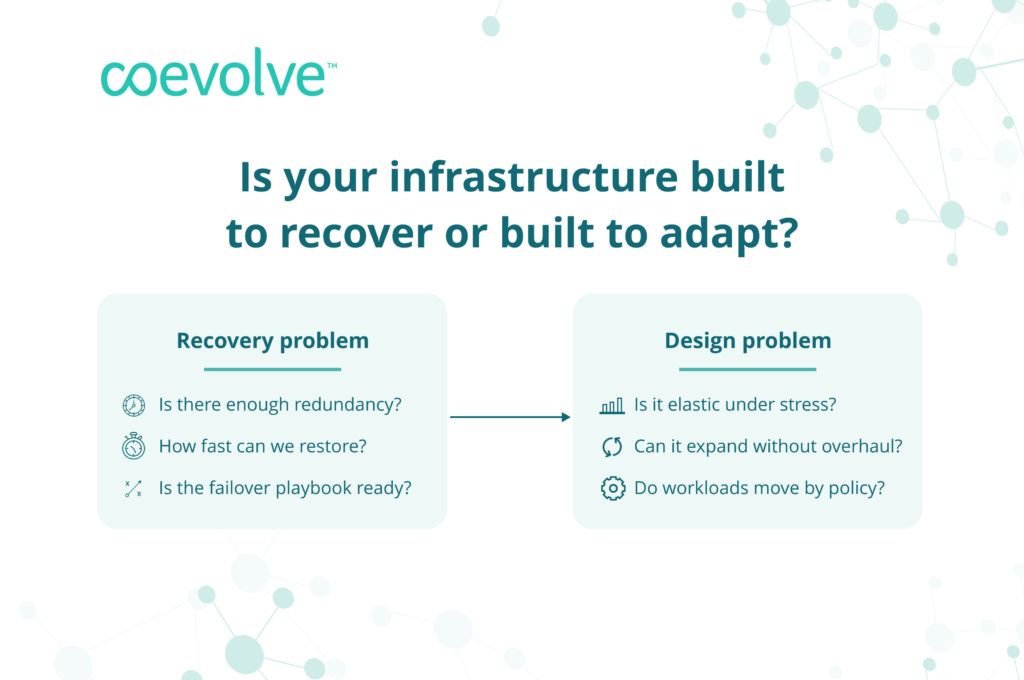
The shift is fundamental: resilience must move from an operational and reactive response to deliberate design. When systems are tightly coupled, failure in any single component cascades quickly across dependent services and results in fragility. But when constructed with modular compute layers that are decoupled from application states, architectures become flexible enough to bend under stress. They can scale on demand and absorb localized failures without suffering operational interruption. They can be proactive rather than reactive.
And because business disruption represents 35 percent of all downtime-related expenses, reactive operational triage is no longer enough. True enterprise resilience requires engineering at the foundational layer long before a disruption occurs.
Building a foundation that can keep pace with business change
A forward-looking and deliberate approach to architectural design enables organizations to prepare for change rather than simply react to it. Well-designed architecture becomes an accelerator for business initiatives, allowing teams to rapidly deploy new services, test AI pipelines, and quickly scale into new regions. But what does “well-designed” look like?
Multiple deployment models
Instead of monolithic stacks and compute capacities tied to physical hardware, hybrid architectures feature decoupled, containerized environments. Single-vendor lock-in is reduced, replaced by seamless integration across private and public clouds, on-premises data centers, and edge endpoints, so businesses have flexibility in configuring their resources.
Dynamic recovery pathways
Multi-region, active-active configurations allow for automated workload evacuation and continuous availability. Rather than rely on manual disaster recovery plans and reactive system rebuilding, resilient architectures deploy automated intervention through policy-as-code for non-disruptive recovery responses. This means recovery can now happen automatically inside the architecture, instead of on an incident bridge in the middle of the night.
Workload placement mobility
Services are virtualized and containerized for fluid movement of application logic and data, so workloads can move between deployment environments based on real-time telemetry and policy. When new data residency requirements arise, workloads can be easily migrated to meet compliance requirements. If there is an unexpected spike in costs, workloads can be seamlessly moved to achieve optimized cost and latency.
Unified data fabric
Rather than fragmented storage silos and brittle batch-replication pipelines, resilient architectures utilize unified data fabrics with federated namespaces across environments. This means that compute pipelines are dynamically routed to where data naturally resides, reducing duplication and egress fees while maintaining continuous data availability.
Policy-driven security
With workloads increasingly migrating across environments, security frameworks can no longer rely on static, perimeter-bound firewalls. Security and compliance guardrails need to be directly embedded into workload packages as code. Modern hybrid architectures deploy data-centric Zero Trust models that travel with workloads to maintain security governance and limit configuration drift.
For enterprises, resilient infrastructure is about more than supporting today’s operational requirements. It provides the flexibility, scalability, and control needed to support future growth initiatives, whether that means scaling AI, entering new markets, modernizing applications, or responding to changing business demands. By combining automation, workload flexibility, data accessibility, and embedded security, organizations can build infrastructure foundations capable of adapting as quickly as the business itself.
Many organizations won't discover infrastructure limitations during day-to-day operations. They'll discover them when a strategic initiative stalls, an AI pilot can't scale, or a new market opportunity demands capabilities their architecture wasn't designed to support.
Intentional architecture is a strategic business imperative
The greatest infrastructure risks are not always the ones that cause outages. More often, they’re the hidden constraints that only become visible when the business needs to move faster.
An AI initiative that cannot progress beyond pilot. A cloud transformation that fails to deliver expected outcomes. A market expansion delayed by data residency requirements. These challenges are often symptoms of architectural decisions that were made for a different era of business and technology.
As organizations pursue growth, technology leaders need greater visibility into the capabilities and limitations of their current environment. Understanding where architectural dependencies exist, how workloads can be scaled, and whether infrastructure can support future business priorities is becoming a critical part of strategic planning.
This is particularly important as AI moves from experimentation to operational deployment. Success will depend not only on access to AI technologies, but on the ability of underlying infrastructure, networks, data platforms, and security controls to support them reliably and at scale.
Organizations that proactively assess and address architectural limitations today will be better positioned to execute tomorrow’s priorities with confidence. Those that don’t may find infrastructure becoming an unexpected barrier to growth. Book an infrastructure assessment to evaluate architectural flexibility and identify opportunities for deliberate design.
Table of contents




FAQs
How do I know if my infrastructure can support future business growth?
Enterprise leaders can assess whether their existing infrastructure supports future business growth by assessing its flexibility, scalability, and responsiveness to change. When systems are outdated and tightly enmeshed, failure in a single function will move quickly along the chain of command, bringing growth to a halt. Robust network infrastructure can be built with a more intentional architectural design, including diverse deployment models, dynamic pathways, and secure data and policies.
How should I design infrastructure for disaster recovery?
Designing infrastructure for disaster recovery and resilience is achieved by asking key questions to improve design, such as: how quickly can our existing system recover from unexpected outages? Are we set up for flexibility, scale, and agility? These traits are pivotal in safeguarding your enterprise against potential disaster, downtime, and cybersecurity threats. Assess whether your architecture is secure and start leading a cultural shift away from reactive to strategic, future-focused decisions.
How can I modernize legacy infrastructure without disrupting the business?
To modernize your legacy infrastructure without disrupting the business, enterprise leaders first need to scrutinize current baseline functionality. This will paint a picture of design gaps and areas for improvement. Enterprises can then forge forward with an architecture modernization that truly addresses business-critical areas. To overcome infrastructure roadblocks sustainably, modernization must be phased and strategic. Do not rush into an overhaul too soon, or disruption is likely to occur.